
AI systems don’t break the QA playbook — they expose which QA practices were already rigorous. Trust in AI comes from transparency: every behavior tested against a defined expectation, every result traceable, every drift caught before it ships. The QA function that earns executive trust on AI is the one that earns it everywhere else.
Why AI looks like a QA problem (and is)
You’ve felt it. The board asked when the AI feature is launching. Then they asked who signs off. Then they asked what “passing” means.
Three questions, one underlying problem: AI systems don’t behave like the software your QA process was built around. Same input, different output. Output looks fine, then drifts a month later. The defect tracker has nothing to say about a model that’s getting subtly worse.
It’s tempting to call this a new discipline. It isn’t. It’s the same craft — validation, traceability, sign-off, regression — with two new questions added: what counts as a passing answer, and how do you prove the answer is still passing six months later. Once those are named, QA on AI is recognizable.
What changes — and what doesn’t — when you QA an AI system
QA in AI systems is the practice of validating non-deterministic behavior against agreed expectations, detecting drift over time, and producing traceable evidence the system performed as intended.
What stays the same:
- Requirements still drive testing — every AI behavior maps to an intended outcome.
- Traceability still matters — every output ties back to inputs, model version, reviewers, and decisions.
- Environment validation still matters — staging needs to mirror production model versions and prompt structures.
- Regression still matters — yesterday’s passing answer still has to pass today.
- Sign-off still matters — somebody, named, takes accountability for shipping.
What changes:
- “Correct” is no longer a single answer. It’s a defined band of acceptable answers, expressed through golden datasets, scoring rubrics, or human review with documented criteria.
- Validation is a cadence, not an event. The system that passed at launch can fail in week six because the model drifted, the inputs shifted, or the world changed.
- Golden datasets become first-class artifacts — versioned, reviewed, kept up to date.
Emerging standards like ISO/IEC 42001 (AI management systems) and the NIST AI Risk Management Framework define what “managed” looks like for organizations operating AI in regulated or high-stakes contexts. The good news for QA leaders: most of what these frameworks ask for is structurally familiar — coverage, traceability, governance — applied to the new questions.
The four dimensions of trust in AI systems
Replace the single “we tested it” claim with a structured signal across four dimensions. Each one is a question with a defensible answer.
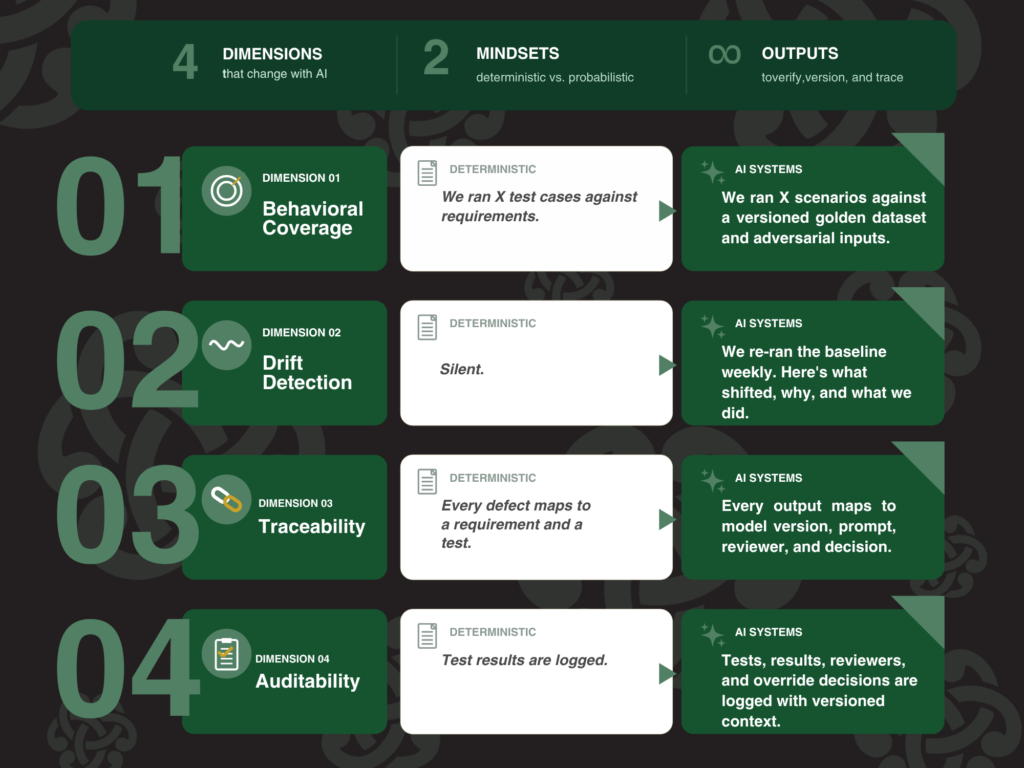
The fourth dimension — auditability — is what separates an AI feature you can defend in a board meeting from one you can’t. When the regulator, the customer, or the executive asks “how do you know it works,” the answer should be the audit trail, not the demo.
The behavioral coverage dimension also brings adversarial testing into scope. The OWASP Top 10 for LLM Applications is a useful starting point for the negative-test scenarios every LLM feature should be tested against — prompt injection, sensitive information disclosure, output handling — even when the AI feature isn’t strictly an LLM.
Where most teams stall — and what gets them moving
Four common stalls show up across the engagements we run:
- Treating AI test as a one-time pre-launch check rather than a cadence. AI doesn’t ship and stay; it drifts. Every AI feature needs a recurring validation cycle from launch onward.
- No agreed definition of “passing” before testing begins. Without it, every test result is debatable. Define the band first.
- Manual review with no traceability artifact. A reviewer signing off in chat or email is not a record. Move review into a structured tool with versioning.
- No drift baseline at launch. If you don’t capture what “good” looked like at week one, drift in week ten is invisible.
The teams that get unstuck don’t add tooling first — they add structure. They name the dimensions, define the band, capture the baseline, and put one person on weekly drift review. Tooling follows.
How CelticQA approaches AI test strategy
We bring the same craft we’ve applied across 20+ years of QA delivery in financial services, healthcare, retail, and logistics — adapted for the two new questions AI raises.
- The QA Maturity Model structures AI testing into the same delivery cadence as the rest of QA — not a parallel track.
- The Quality Management Office (QMO) framework gives AI release decisions the same governance rigor as any other release decision.
- The Accelerate Automation Program scales test coverage against golden datasets — the same way it scales regression suites.
- IV&V (Independent Verification & Validation) gives AI features an independent eye when the team that built the model is also testing it.
- Where traceability is the bottleneck, QAConnector captures the input-model-output-reviewer chain in a single audit trail.
For more on how traceability earns reporting trust at the executive level, see our companion piece on Why Data Quality Beats Data Volume.
Frequently asked questions
What is QA for AI systems? QA for AI systems is the practice of validating non-deterministic behavior against agreed expectations, detecting drift over time, and producing traceable evidence the system performed as intended. The core craft is unchanged from traditional QA; what changes is the definition of “passing.”
How is testing AI different from testing software? Traditional software has deterministic outputs — same input, same result. AI outputs vary by model version, prompt, and context. AI testing requires golden datasets, drift baselines, adversarial inputs, and an agreed-on definition of acceptable behavior before testing begins.
What does “trust” mean in AI testing? Trust in AI testing means executives and auditors can see, in evidence, that the system was tested against defined expectations, that results were traceable, and that drift was caught before it shipped. Trust is the byproduct of transparency, not a separate feature.
What metrics matter for AI release readiness? Behavioral coverage against golden datasets, drift against agreed baselines, traceability of input → output → reviewer → decision, and auditability of who tested what when. Defect counts alone don’t translate to AI release confidence.
How quickly can a QA team add AI testing to its cadence? Most QA teams can stand up an initial AI test cadence within one quarter. Golden datasets in week 1–2, drift baselines in week 3–4, full traceability artifacts by month 2. Full operationalization across multiple AI features takes a quarter or two.
Trust isn’t a feature. It’s a cadence.
The change isn’t in adopting AI testing tools. It’s in committing to the cadence: define the band, capture the baseline, run the cycle, log the trail. Once that cadence is in place, AI systems become defensible the same way any system becomes defensible — through evidence.
When AI quality becomes the gating decision for your next release, schedule a CelticQA consultation. We’ll walk through how the QA Maturity Model adapts to AI testing in your stack — usually within a quarter.
