
A quality culture in software development makes quality everyone’s job, not just QA’s. When developers, testers, product owners, and leaders share ownership, defects are caught earlier, rework drops, and handoffs shrink. The result is faster, more predictable delivery. New tools can’t deliver that on their own; culture is what lets them work.
Introduction
Install the latest software on an outdated operating system and you know what happens. Everything lags. Features don’t work the way the vendor promised. People find workarounds.
Software delivery works the same way. Organizations invest in automation, CI/CD pipelines, and AI-assisted testing, then wonder why releases still slip. Often the tools aren’t the problem. The culture they run on is. When quality belongs to one team at the end of the line, every new tool inherits the same delays.
This post covers what a quality culture is, how it affects delivery speed, the signs yours needs an upgrade, and the practical steps to make that upgrade.
What is a quality culture?
A quality culture is a way of working where everyone (developers, testers, product owners, and leaders) shares ownership of software quality, catches problems early, and measures outcomes openly, instead of leaving quality to a final QA gate.
In practice, that means three things:
- Shared ownership. Developers write testable code and care about regression risk. Product owners write clear acceptance criteria. QA shapes the strategy instead of only executing it.
- Early feedback. Testing starts with requirements, not after code freeze.
- Visible outcomes. Teams track defect escape rate, rework, and release confidence together, and talk about them without blame.
At CelticQA, we put it simply: quality is the responsibility of everyone in the organization.
How does culture affect software delivery speed?
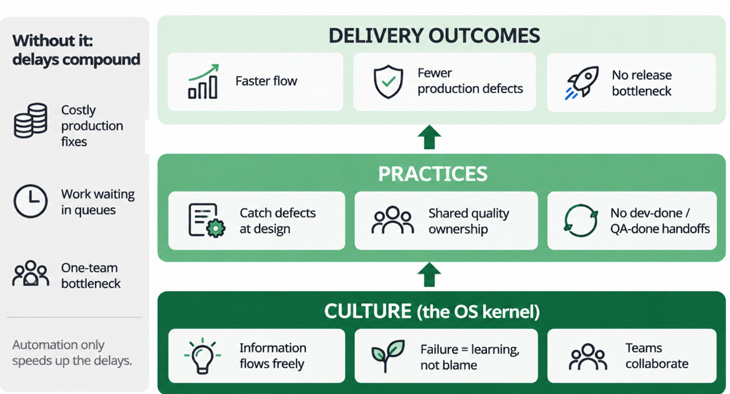
Slow delivery rarely comes from one big failure. It comes from small delays that compound:
- A defect found in production costs far more to fix than one caught during design, and it pulls engineers off planned work.
- Handoffs between “dev done” and “QA done” create queues where work sits waiting.
- When quality is one team’s job, that team becomes the bottleneck before every release.
Research backs the link between culture and performance. DORA’s research on generative culture has found that a high-trust culture, where information flows freely across teams, predicts software delivery performance.
The takeaway: you can’t automate your way past a culture problem. You can only automate the delays faster.
5 signs your quality culture needs an upgrade
- QA is the gatekeeper, not a partner. Testing happens after development, and QA’s job is to say yes or no.
- Defects are found late. Most bugs surface in system testing or production instead of during requirements and development.
- Problems lead to blame. When a release fails, the conversation is about who missed it rather than what the process missed.
- Regression is mostly manual. Every release needs days of repeat testing, so teams batch changes and ship less often.
- Quality metrics are invisible. Leadership sees test counts, or nothing, instead of trends in escaped defects and rework.
If three or more of these sound familiar, your tools are likely running on an outdated operating system.
Quality culture vs. quality process
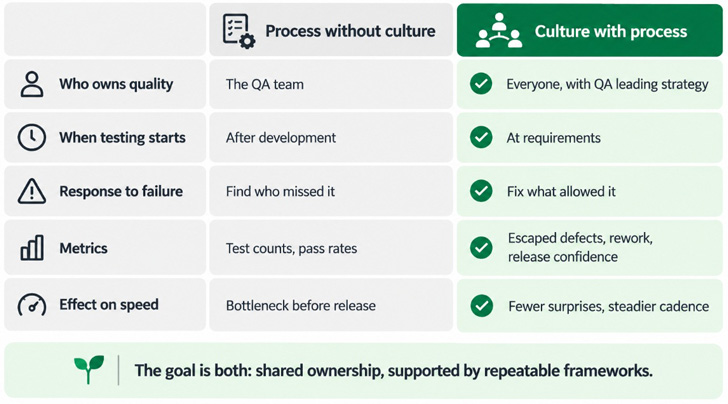
| Process without culture | Culture with process | |
| Who owns quality | The QA team | Everyone, with QA leading strategy |
| When testing starts | After development | At requirements |
| Response to failure | Find who missed it | Fix what allowed it |
| Metrics | Test counts, pass rates | Escaped defects, rework, release confidence |
| Effect on speed | Bottleneck before release | Fewer surprises, steadier cadence |
Process still matters. A strong culture with no structure turns into good intentions. The goal is both: shared ownership, supported by repeatable frameworks.
How to upgrade your quality culture
You don’t need a big-bang reorg. Most teams make the upgrade in steps:
- Baseline where you stand. Take an honest look at how QA works today, across people and process, not just tools. Our QA Maturity Scorecard is a self-assessment your team can complete on its own to see where culture is creating drag. When CelticQA leads QA on a project, that evaluation is built into the work, so improvements start right away instead of waiting on a separate assessment.
- Agree on shared metrics. Pick two or three outcome measures, such as defect escape rate and rework, and review them across dev, QA, and product every sprint.
- Embed QA in the team. Bring QA into backlog refinement and design so acceptance criteria and test approach are set before code is written. Our rule is simple: if it can’t be tested, it isn’t ready to be built. In a CelticQA Quality Management Office (QMO), requirements are scored for testability before design or build begins, and a shared QA Playbook defines who owns what.
- Automate the repetitive work. Manual regression keeps teams batching releases. Our Accelerate Automation Program delivers up to 80% reduction in manual testing effort, freeing people for the exploratory and strategic testing that needs human judgment. At Boston Children’s Hospital, regression cycle times fell by 90%.
- Make quality visible. QMO governance and a shared QA management platform like QAConnector, CelticQA’s single source of truth for requirements, tests, and defects, give everyone the same view of quality, from coverage and open risk to go-live readiness. Conversations become about trends, not opinions.
Not sure where to start? Take the QA Maturity Scorecard self-assessment to see where you stand. If a major go-live is coming up, ask about an Independent Release Readiness Review: we’ll score the requirements on one in-flight project against our Requirements Quality Scorecard and give you an independent view of go-live risk.
FAQ
What is a quality culture in software development?
A quality culture is a way of working where the whole team shares ownership of software quality. Developers, testers, product owners, and leaders catch problems early and measure outcomes openly, rather than relying on a final QA gate to find defects before release.
How does culture affect software delivery speed?
Culture determines when defects are found and how work flows between teams. When quality is shared, problems surface early and cost less to fix. When it sits with one team at the end, late defects, rework, and handoff queues slow every release.
Who is responsible for quality in an agile team?
Everyone. Developers own code quality and unit tests, product owners own clear acceptance criteria, and QA leads the test strategy, risk assessment, and automation approach. Leaders own the metrics and the expectation that quality is part of done.
How do you build a quality culture?
Start with an honest baseline of how QA works today (a self-assessment is a good first step), agree on shared outcome metrics, bring QA into planning, automate repetitive regression, and make quality data visible to everyone. Small, consistent changes work better than a one-time reorganization.
How do you measure quality culture?
Look at outcomes that reflect behavior: defect escape rate, rework as a share of effort, how early defects are found, and release confidence. Trends over time show whether shared ownership is taking hold.
Can test automation fix a weak quality culture?
Not on its own. Automation speeds up repetitive testing, but if teams still treat quality as QA’s job, defects keep arriving late. Automation works best when it supports a culture of shared ownership and early feedback.
Conclusion
Tools are the apps. Culture is the operating system they run on. When quality is everyone’s job, teams find problems earlier, spend less time on rework, and ship on a steadier cadence. When it isn’t, every new tool inherits the same delays.
The upgrade doesn’t need to be dramatic. Baseline where you stand, share the metrics, bring QA in earlier, and automate what slows you down.
Ready to upgrade the system everything else runs on? Talk to the CelticQA team about how a Quality Management Office improves culture and delivery together.
