
The first-mover vs. fast-follower debate has shaped technology strategy for decades — but it may be the wrong frame entirely. Organizations that consistently win with new technology aren’t necessarily the first to adopt it or the wisest to wait. They’re the ones with the quality infrastructure to absorb, validate, and scale what they adopt. Quality readiness, not adoption timing, is the deciding variable.
The First-Mover vs. Fast-Follower Debate (and Why It’s Incomplete)
The case for moving first sounds compelling: capture competitive advantage before peers, shape vendor roadmaps in your favor, attract talent that wants to work on what’s next. The case for waiting sounds equally compelling: let someone else absorb the cost of immature ecosystems, learn from the failures that make the front page of tech news, and adopt a version of the technology that’s actually ready for production.
Both arguments have merit. Both are also incomplete — because they treat timing as if it’s the primary variable. It isn’t.
What first-mover advantage actually costs
In consumer markets, first-mover advantage is real and well documented. In enterprise technology adoption, the relationship is more complicated. Early adopters of enterprise platforms—ERP modernization, cloud migrations, robotic process automation, and now generative AI—often bear the costs of immature vendor ecosystems, limited implementation expertise, evolving governance models, and incomplete integration tooling. As technologies mature, implementation methodologies, partner ecosystems, and organizational playbooks improve, allowing later adopters to execute with lower risk and greater predictability. Gartner’s research underscores this challenge: the firm predicts that more than 70% of recently implemented ERP initiatives will fail to fully achieve their original business-case objectives by 2027, highlighting how implementation maturity and organizational readiness frequently matter more than being first to adopt. Later adopters benefit from lessons learned, proven deployment patterns, and a more mature ecosystem that can significantly reduce execution risk.
The hidden cost isn’t always in the technology budget. It shows up in defect escape rates, in integration work that becomes technical debt, and in the organizational trust lost when an ambitious rollout underdelivers.
The fast follower’s structural edge
Fast followers don’t have a speed advantage — they have a learning advantage. By the time they adopt, the vendor has addressed the issues that bit early customers, the implementation playbook is more mature, and the talent market includes practitioners with real production experience.
But fast followers make their own mistakes. The most common: treating the learning advantage as a license to skip the quality groundwork. They see the technology as de-risked by others’ experience. It isn’t. Their risk isn’t the technology — it’s their own organization’s readiness to absorb it.
The Variable Everyone’s Missing: Quality Readiness
Quality readiness is the capacity of an organization to adopt, validate, and integrate new technology without introducing unacceptable risk into existing systems or delivery cycles.
It’s not a single capability. It’s a stack: test coverage that maps to business requirements, automation frameworks that can be extended to new components, and QA leadership embedded early enough to influence how something is built rather than just test it after the fact. And it’s a posture — the organizational expectation that quality work is part of adoption, not a cleanup task after go-live.
What quality readiness means in practice
In practical terms, a quality-ready organization can answer yes to these questions before adopting new technology:
- Do we have test coverage for the systems this technology will touch?
- Can we run regression tests fast enough to keep pace with adoption milestones?
- Is QA leadership involved in the implementation decision, or only in the testing phase?
- Do we have documented acceptance criteria for what “ready” looks like before go-live?
- Can we instrument the new technology for monitoring and alerting from day one?
Most organizations can answer yes to one or two. Organizations that consistently win with new technology — first mover or fast follower — tend to answer yes to all five.
Three signs your organization isn’t ready (regardless of timing)
1. QA is scoped as a phase, not a practice. If your QA effort starts when development ends, the adoption cycle will introduce defects that compound over time. Quality needs to be embedded from requirements through release.
2. Test automation coverage is concentrated in happy paths. New technology introduces edge cases. If your regression suite only covers expected behavior, you won’t catch the failure modes that matter most in production.
3. Your QA team is learning the new technology at the same time as the developers. This isn’t always avoidable — but it means the adoption curve is compressing QA capacity precisely when you need more of it. Organizations with stronger QA maturity build ramp time into the adoption plan explicitly.
How Quality Readiness Changes the Adoption Equation
When quality readiness is high, the first-mover vs. fast-follower decision becomes less existential. A quality-ready organization can absorb early-adoption risk more efficiently because it has the testing infrastructure to catch and contain issues before they propagate. It can absorb the compressed timeline of fast following more efficiently because it isn’t building QA from scratch during implementation.
Automation coverage as a strategic asset
Test automation is often discussed as a cost-saving measure. It is — CelticQA’s Accelerate Automation Program delivers up to 80% reduction in manual testing effort for qualifying teams. But for technology adoption specifically, automation coverage is a strategic enabler. It’s what allows a team to adopt something new without pulling QA capacity off everything else.
Organizations with strong automation coverage can run full regression against existing systems while allocating QA capacity to the new technology being adopted. Organizations without it face a zero-sum allocation problem: test the new thing or protect the existing stack. That tradeoff is where adoption risk actually lives.
The role of QA maturity before you adopt
CelticQA’s QA Maturity Assessment & Roadmapping evaluates an organization’s current QA state across five dimensions: people, process, tooling, automation, and governance. The output is a QA Roadmap — a prioritized, practical plan for strengthening what matters most before the next major adoption cycle begins.
For organizations planning a significant technology change in the next 12–18 months, a maturity assessment is one of the most efficient investments available. It surfaces the gaps that will become problems during adoption — when fixing them costs the most — and gives the team a prioritized path to close them while there’s still time.
What IT Leaders Get Right (and Wrong) About Adoption Timing
The most effective technology leaders tend to agree on one thing: the timing decision is secondary to the readiness decision. Here’s how that plays out in practice.
What they get right:
- They treat quality readiness as a precondition for adoption, not a parallel workstream
- They resource QA proportionally to the scope of the adoption — not as an afterthought
- They define “done” in quality terms (coverage targets, defect escape thresholds) before go-live, not after
What even experienced leaders get wrong:
- Assuming a stable existing system equals quality readiness for adoption — existing systems with low test coverage are precisely the ones that break when something adjacent changes
- Treating QA as a gating function rather than an enabling one — quality work should accelerate adoption, not slow it
- Underestimating QA ramp time on unfamiliar technology and not accounting for it in the adoption plan
5 questions to ask before adopting a new technology
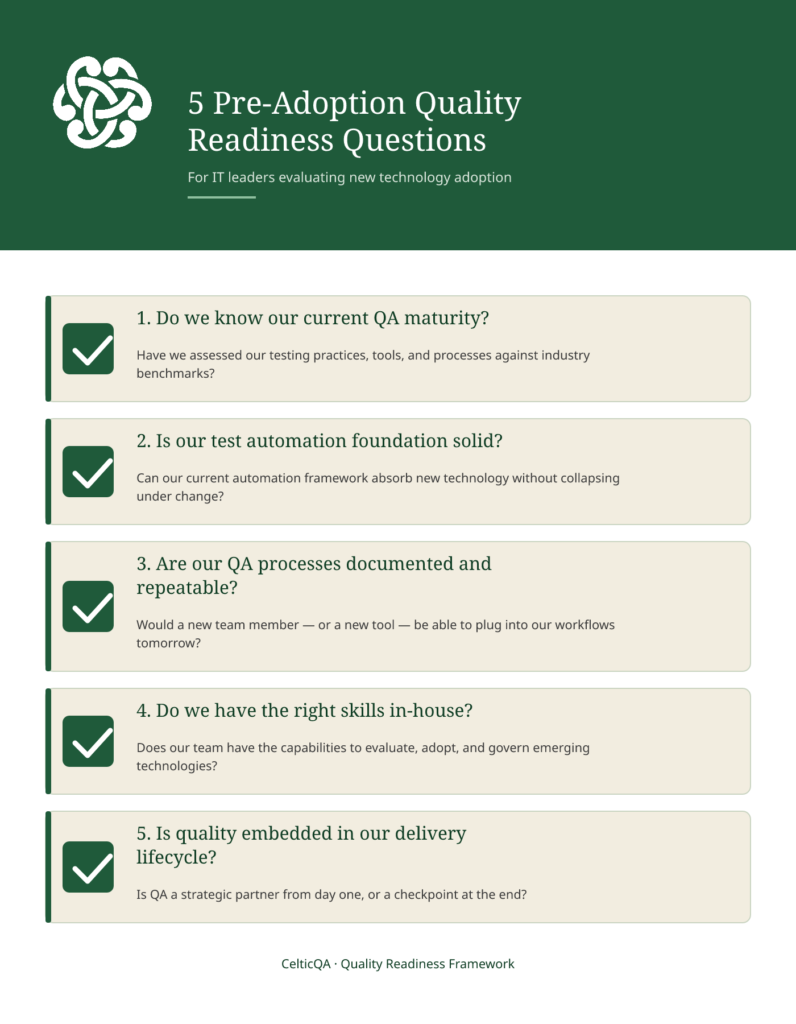
- What is our current regression test coverage, and does it include the systems this technology will connect to?
- Can our automation framework be extended to cover the new technology, or will we build automation from scratch in parallel with adoption?
- Is QA represented in the vendor selection and implementation planning process?
- Have we defined our quality exit criteria for go-live — and are they written down?
- Do we have the QA capacity to support adoption without starving the existing delivery pipeline?
If the answers to more than two of these are “no” or “not sure,” that’s not an argument against adoption — it’s an argument for addressing quality readiness before the adoption timeline begins in earnest.
Thinking about a technology adoption in the next 12–18 months? Explore how a QA Maturity Assessment can surface what’s in the way.
Building the Quality Foundation That Makes Timing Matter Less
The organizations that consistently outperform on technology adoption aren’t necessarily smarter about timing. They’ve built a quality foundation that makes timing matter less.
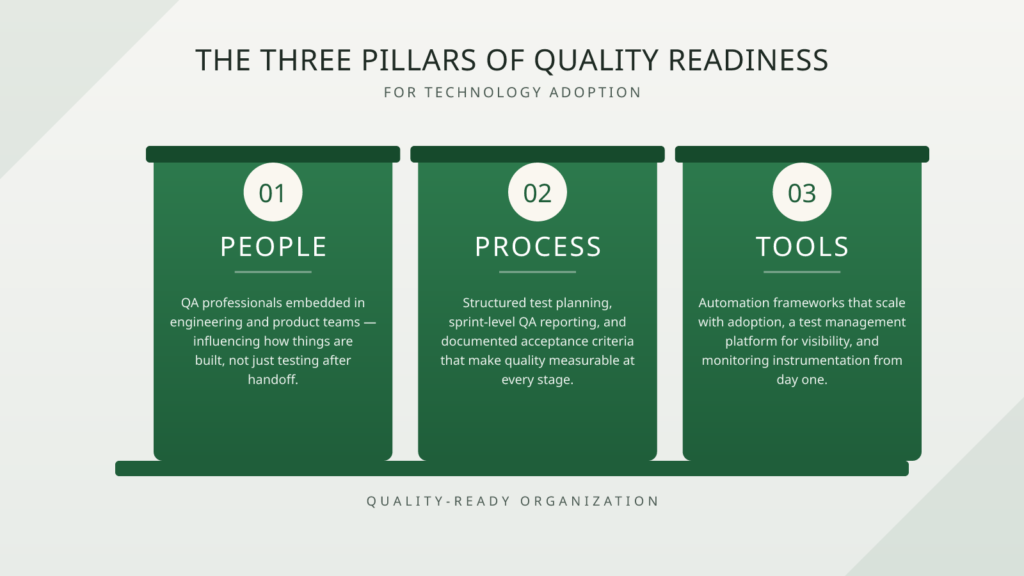
That foundation has three components.
People: QA professionals embedded in engineering and product teams, not siloed in a QA department that receives handoffs. Skilled QAs influence how things are built, not just whether they pass a checklist.
Process: Structured test planning, sprint-level QA reporting, and documented acceptance criteria that make quality measurable at every stage — not just at go-live.
Tools: Automation frameworks that can scale with the technology being adopted, a test management platform that provides visibility across teams, and monitoring instrumentation that catches what testing misses.
Starting with a QA Maturity Assessment
For organizations that know they need to strengthen their quality foundation but aren’t sure where to start, the QA Maturity Assessment & Roadmapping service is the most efficient entry point. It delivers a clear picture of current state, a prioritized roadmap, and — critically — a shared language between QA and engineering leadership for discussing quality investment in business terms. Engagements typically take 4–6 weeks from kickoff to roadmap delivery.
Frameworks that transfer capability
The goal of any quality engagement should be capability transfer, not permanent dependency. CelticQA’s frameworks are built to be owned by the client team over time. The QA Maturity Model gives engineering leaders a consistent language for assessing and improving QA maturity. The Accelerate Automation Program leaves reusable automation assets behind when the engagement is complete. That’s the difference between a QA vendor and a QA partner.
FAQ: First Mover vs. Fast Follower and Quality Readiness
What is the difference between a first mover and a fast follower in technology adoption? A first mover is the first organization in its competitive set to adopt a new technology. A fast follower deliberately waits — typically 6–24 months — to learn from first movers’ experiences before adopting. In enterprise IT, fast followers often benefit from more mature vendor products, lower implementation costs, and a larger pool of practitioners with direct production experience.
Does first-mover advantage apply in enterprise technology? Less reliably than in consumer markets. Enterprise technology adoption carries significant implementation cost and integration complexity. First-mover advantage tends to apply when the technology creates genuine, hard-to-replicate competitive differentiation — and when the organization has the quality infrastructure to absorb early-stage risk. Without that foundation, first movers often become first victims.
What is quality readiness? Quality readiness is the capacity of an organization to adopt, validate, and integrate new technology without introducing unacceptable risk into existing systems or delivery cycles. It encompasses test coverage, automation maturity, QA leadership involvement, and defined acceptance criteria for technology changes.
How does test automation affect technology adoption speed? Automation coverage reduces the zero-sum tradeoff that slows many adoptions: the tension between testing the new technology and protecting the existing stack. Organizations with strong automation coverage can run continuous regression on existing systems while directing QA capacity toward new technology adoption, enabling faster and safer rollouts.
When should we do a QA Maturity Assessment? Ideally, 6–12 months before a major technology adoption cycle begins — while there’s still time to address gaps before the timeline compresses everything. A QA Maturity Assessment maps current state, identifies the highest-risk gaps, and produces a prioritized roadmap. CelticQA’s QA Maturity Assessment & Roadmapping typically delivers a roadmap within 4–6 weeks of kickoff.
Can a fast follower outperform a first mover? Consistently, yes — when the fast follower has stronger quality readiness. Learning from others’ early adoption mistakes only helps if you can execute faster and more cleanly when you do adopt. Quality readiness is what makes that faster, cleaner execution possible.
Quality Readiness Is the Competitive Advantage You Can Build Before You Need It
The first-mover vs. fast-follower debate won’t be resolved — it’s context-dependent, competitive-landscape-dependent, and board-dependent. But quality readiness isn’t. It’s a capability that compounds: the stronger your quality foundation, the less it costs to adopt any new technology, whenever you choose to adopt it.
The organizations that consistently win with new technology have figured this out. They invest in quality infrastructure during the calm, so they can move confidently during the storm.
Ready to assess your organization’s quality readiness before your next technology adoption? Connect with a CelticQA strategist to learn how the QA Maturity Assessment & Roadmapping service can help.
