
Building audit-ready QA traceability around Jira requires more than linking test cases to issues — it requires a structured QA process that connects requirements, test design, execution, and defect management in a single chain. CelticQA’s QA Strategy services and QA Maturity Model provide the process framework; QAConnector closes the tooling gap.
The Traceability Problem Most Jira Teams Don’t Realize They Have
Jira is the backbone of most modern software delivery workflows, and for good reason — it is an exceptionally capable issue-tracking and project management platform. But “your test cases are tracked in Jira” and “you have QA traceability” are not the same thing.
Here is the pattern CelticQA sees most often in QA Maturity Assessments: a team uses Jira stories as informal requirements, creates test cases as Jira sub-tasks or custom issue types, logs defects as bugs, and at the end of each sprint produces a coverage report by manually counting which stories have linked test issues. The process looks connected. It is not traceable.
See CelticQA’s QA Strategy services →
The gap surfaces at audit time, or when a regression surfaces a defect that everyone assumed was covered. Nobody can answer: “Which requirement was this test case designed to verify? Was it executed? Did it pass?” The records exist — somewhere in Jira — but they were never structured to answer that question.
What “Audit-Ready” QA Traceability Actually Requires
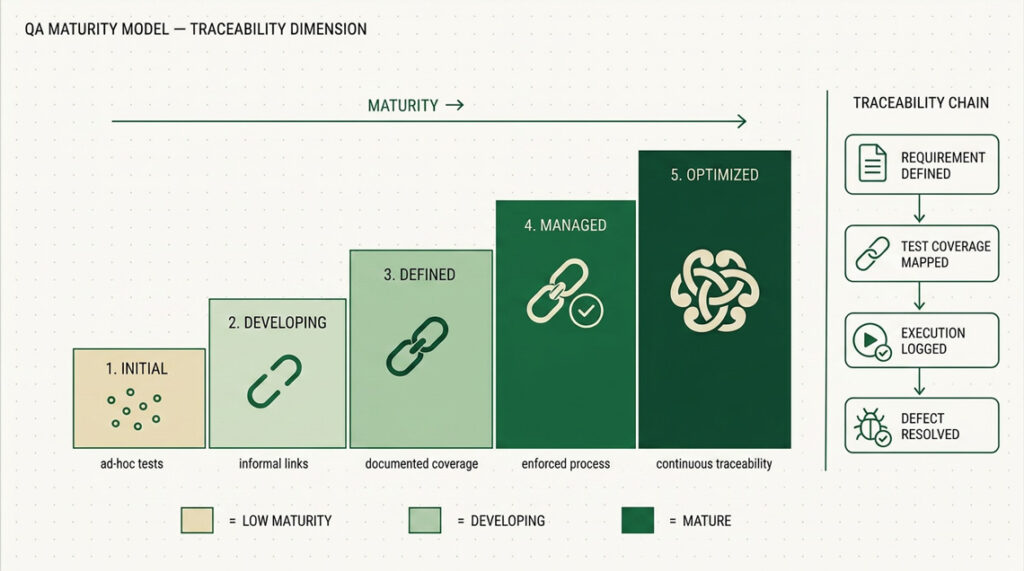
Audit-ready QA traceability is the structured, documentable ability to answer four questions about any requirement in your system:
- Is it defined? A requirement is documented with enough specificity to write a test case against it.
- Is it covered? One or more test cases map explicitly to this requirement, covering both positive and negative paths.
- Was it tested? Execution results for those test cases are logged, timestamped, and attributed.
- Were issues resolved? Any defect found during testing is linked to the originating requirement and marked resolved only after a re-test pass.
These four components — definition, coverage, execution, and resolution — are the ones every external auditor and every internal compliance review will ask about. The specific tool used to capture them matters less than whether the structure exists to produce them on demand.
Most Jira-based QA workflows can answer question three (was it tested, sometimes). They struggle with questions one, two, and four — not because Jira can’t hold the data, but because the process to capture it in a structured, traceable way was never designed.
Why Traceability Is a QA Maturity Problem, Not a Tool Problem
The most common response to a traceability gap is to buy a tool. The team evaluates Jira plugins, test management add-ons, or standalone platforms. Sometimes a tool helps. Often the gap reopens within two sprints.
The reason: traceability failures are almost always upstream of the tooling. The problem is in how requirements are written, how coverage ownership is assigned, and how the sprint-close process is run — not in which fields the test management tool presents.
CelticQA’s QA Maturity Model consistently surfaces this finding. Teams at the “Managed” and “Optimized” maturity levels have traceability. Teams at “Initial” and “Developing” levels don’t — regardless of toolchain. The difference is not the software. It is whether the process to use that software was defined, documented, and enforced.
This is the non-consensus take worth naming directly: the traceability gap in most Jira teams is a QA process maturity problem, not a Jira problem. Jira is a capable platform for the job it was designed to do. The engineering team did not buy a project management tool expecting it to generate a requirements coverage matrix. That expectation gap is where the gap lives.
A Framework for Building Traceability Into Your Jira QA Process
Fixing the traceability gap is a five-step process. The steps are sequential — skipping step two to get to step three is why most tool implementations fail.
Step 1: Define requirements in a format that maps to test cases.
A Jira story title (“User can reset password”) is not a requirement in a traceable sense. A traceable requirement includes acceptance criteria specific enough that a QA engineer can derive positive test cases (the happy path), negative test cases (invalid inputs, boundary conditions), and edge cases (concurrent sessions, timeout scenarios). Structuring requirements this way is not a tool task — it is a discipline the development and QA teams build together.
Step 2: Assign coverage ownership.
Every requirement needs an owner responsible for confirming it has test coverage before the sprint closes. This is typically the QA lead for the story, but the assignment must be explicit. “Everyone is responsible for coverage” means no one is.
Step 3: Connect your QA management layer to Jira — as architecture, not workaround.
This is where tooling enters correctly: after the process is defined, not before. QAConnector’s Jira integration allows Jira stories to import as requirements and defects to sync bi-directionally — so the traceable chain is maintained in a dedicated QA management platform while developers continue to work in Jira natively. TestGen AI in QAConnector can generate test cases from the acceptance criteria in step one, closing the loop from requirement definition to test design in one workflow.
Step 4: Make sprint-close coverage review non-negotiable.
Two days before every sprint close, run a coverage review against the requirements traceability matrix. The question is not “did we run all our test cases?” — it is “do all requirements have test cases, and were those test cases executed?” Any untested requirement caught two days before the release date can still be addressed. One caught the morning of the release review cannot.
Step 5: Export structured coverage records as you go — not only when audited.
The teams with the least stressful audit cycles are the ones who produce structured coverage exports at the end of every sprint, continuously. The Accelerate Automation Program and QAConnector’s Audit-Proof QA export together make this a five-minute task at sprint close — a timestamped, role-gated, structured record that requires nothing additional when compliance reviews arrive.
What CelticQA’s QA Strategy Service Adds
Process frameworks are straightforward to describe. Implementing them in a real engineering organization — with existing sprint rhythms, existing tooling decisions, and existing team habits — is where outside expertise earns its place.
CelticQA’s QA Maturity Assessment & Roadmapping service begins with a structured assessment of where your organization’s QA practice currently sits across key dimensions, including traceability and coverage. It produces a QA Roadmap — a prioritized set of improvements that tells the team what to fix first, in the right order, for measurable impact.
For teams where automation is the right accelerator, the Accelerate Automation Program delivers up to 80% reduction in manual testing effort — with the traceability framework built in, not bolted on after.
And for organizations that need IV&V (Independent Verification & Validation) — an independent QA review separate from the development team — CelticQA provides that as part of the QA Strategy service line.
Download the QA Traceability Readiness Checklist — five questions your engineering leadership should be able to answer about your current Jira-based QA process
FAQ — Building QA Traceability Around Jira
What is QA traceability and why does it matter for Jira teams? QA traceability is the ability to follow a requirement from its definition through test design, execution, and defect resolution — confirming every requirement has been tested and every defect is linked to its source. For Jira teams, traceability is what turns sprint velocity data into release confidence and audit-ready documentation.
Is Jira enough for QA traceability, or do teams need a separate platform? Jira handles issue tracking and sprint management well. For structured end-to-end QA traceability — connecting requirements, test cases, execution records, and defects in an auditable chain — most teams benefit from a dedicated QA management layer. QAConnector integrates with Jira specifically to close this gap without replacing the tools your developers already use.
How does CelticQA’s QA Maturity Assessment help with Jira traceability? The QA Maturity Assessment evaluates your QA practice across key dimensions including coverage and traceability. It surfaces whether the gap is a process problem, a tooling problem, or both — and the QA Roadmap prioritizes which to fix first. Most clients see measurable improvement within two to three sprint cycles of implementing the roadmap.
What does audit-ready QA mean in practice? Audit-ready QA means your organization can produce, on demand, a complete structured record of what was required, what was tested, how tests executed, and which defects were found and resolved — with timestamps and requirement linkage. The goal is that audit prep takes minutes, not days, because the documentation was built continuously rather than assembled at the last moment.
Why do most tool implementations fail to fix the traceability gap? Because the gap is upstream of the tooling. Teams implement test management tools before defining how requirements are structured, who owns coverage, and how sprint-close reviews are run. A tool cannot create process discipline that was never designed. The right sequence is: define the process, then implement the tool to support it.
What is the first step for a team that knows it has a Jira traceability gap? Start with an honest assessment of your current QA maturity — not in your tooling, but in your process. Can every engineer on your team answer: “Which requirement is this test case designed to verify?” If not, that is the starting point. CelticQA’s QA Maturity Assessment provides a structured version of this diagnostic.
The First Step Is Knowing Where Your QA Process Stands
Traceability is not a feature you turn on. It is an outcome of a QA practice that was deliberately designed — with clear requirements, explicit coverage ownership, a connected toolchain, and a sprint-close discipline that enforces the chain before the release date, not after.
The five-step framework above is the path. Whether your team needs outside expertise to implement it depends on where you are starting.
Schedule a QA consultation → and start with a QA Maturity Assessment to see exactly where your traceability gaps are — and what to do about them first.
