
For most technology leaders, an audit isn’t where the work begins. It’s where the work gets examined. Audit readiness means being able to show, at any point, that a requirement was tested, a defect was resolved, and a release was approved with evidence to back it up. Most teams can’t answer that on demand. Here’s why, and what changes it.
The scramble isn’t really about the audit
Too many organizations wait until an auditor asks for evidence before discovering how difficult that evidence is to produce. When the request finally lands, it triggers the same six questions:
– What was tested before the last release?
– Which requirements were covered?
– What failed?
– Were the defects remediated?
– Who approved the release?
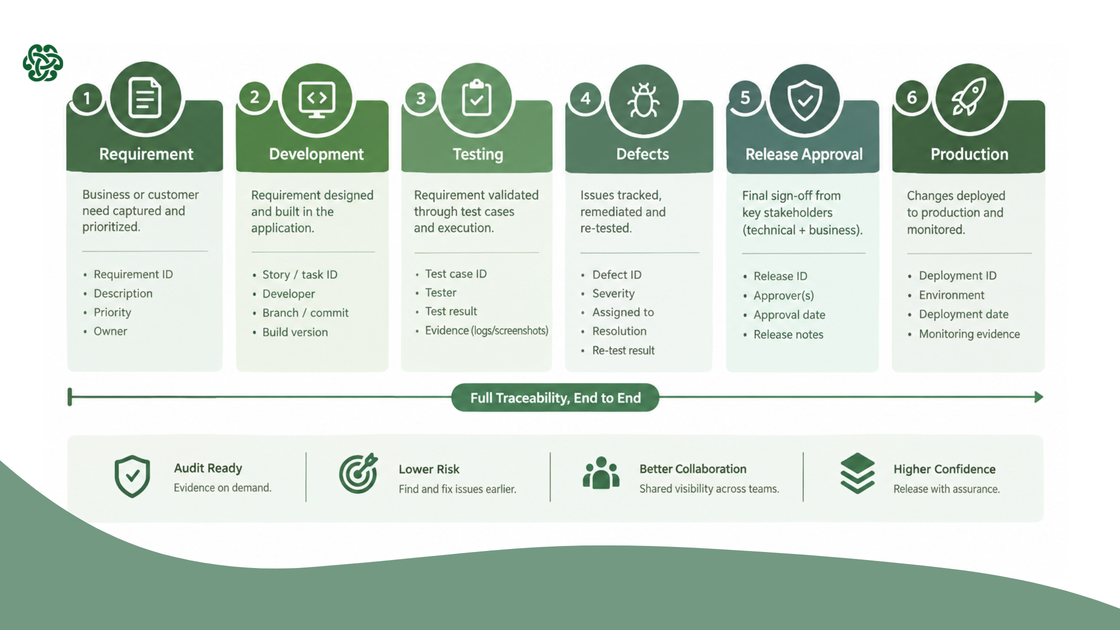
– Can you trace a requirement from development through testing and final sign-off?
When those answers require spreadsheets, old emails, screenshots, ticket searches, and a conversation with someone who worked on the project months ago, the real issue isn’t the audit. It’s the process that came before it.
Audit readiness starts much earlier than the audit
Strong audit readiness should be a natural byproduct of how technology projects are managed and executed, not a separate scramble bolted on afterward. That’s where quality engineering earns its keep.
When QA is involved early in the software development lifecycle, teams can establish traceability from requirements through testing, defects, remediation, and release decisions. Instead of reconstructing the story later, the evidence gets created as the work happens. A QA Strategy built around QA roadmaps and governance models, not just test scripts, is what makes that possible.
With that foundation in place, organizations can answer questions that go well beyond audit prep:
– Was the requirement adequately tested?
– What was the test result?
– Were exceptions identified and addressed?
– What remained unresolved at release?
– Who made the decision to proceed?
– Is there evidence supporting that decision?
Those aren’t just audit questions. They’re technology risk questions — the same ones a VP of Engineering should want answered before a release ships, audit or no audit.
QA should do more than prove the system works
The role of QA shouldn’t be limited to validating software after development is complete. A mature quality engineering function has a voice early and often throughout the SDLC, helping establish how quality will be measured, what needs to be validated, how risk will be identified, and how results will be documented.
CelticQA’s QA Maturity Model exists for exactly this reason: it assesses where a team’s QA discipline stands today and produces a QA Roadmap for closing the gaps, including the traceability gaps that surface during an audit. A Quality Management Office (QMO) framework gives engineering leaders a standardized way to apply that discipline consistently across teams, rather than reinventing it project by project.
That shifts the question QA is answering. It’s no longer just “did we test it?” It becomes “do we have confidence that this technology is ready for the business to depend on it?” When that discipline runs throughout the lifecycle, audit readiness stops being a special project; it becomes a byproduct of how the team already works.
Automation makes the process repeatable
Audit readiness can also become unnecessarily labor-intensive when organizations lean heavily on manual testing and manual evidence collection. Every audit cycle means re-proving what should already be provable.
Automation changes that math. CelticQA delivers automated regression testing, repeatable validation processes, and centralized test management through the Accelerate Automation Program and the QAConnector Test Management Tool. Together, they produce more consistent results while reducing the effort required to repeatedly demonstrate that critical functionality still works as intended
AI adds another layer of opportunity here, not as a standalone claim, but as a specific capability: accelerating test case creation so teams can increase coverage without proportionally increasing manual effort. The goal isn’t automation for its own sake. It’s a quality process that’s repeatable, traceable, and defensible by design.
What this looks like in practice
This is where Independent Verification & Validation (IV&V) earns its place in the conversation. IV&V brings an independent set of eyes to validation — separate from the team that built the system — which is exactly the kind of evidence an auditor (or a CIO, or a board) wants to see: not just “we tested it,” but “someone independent confirmed it.”
CelticQA doesn’t perform financial or compliance audits. We help organizations build the quality engineering discipline that supports audit readiness: leading, managing, and executing QA alongside our clients’ teams, and putting the processes, independent validation, automation, traceability, and reporting in place throughout the technology lifecycle.
The goal is bigger than helping an organization answer an auditor’s question well. It’s helping leadership have confidence in the answer before anyone asks. If you want a clear-eyed view of where your own traceability gaps are, a QA Maturity Assessment is the place most teams start.
Frequently asked questions
What does “audit readiness” mean in a QA context?
It means being able to show, on demand, that requirements were tested, defects were tracked and resolved, and releases were approved with evidence, without reconstructing that story after the fact.
Is audit readiness the same as a compliance or financial audit?
No. CelticQA doesn’t perform financial or compliance audits. Audit readiness here refers to the QA discipline and traceability that make it easy to produce evidence when any audit (compliance, security, or internal) asks for it.
When should QA get involved to support audit readiness?
As early as possible. Ideally from the requirements stage, so traceability exists from day one rather than being reconstructed later.
What does traceability actually require?
A documented line from requirement to test case to result to defect (if any) to remediation to release sign-off, consistently captured, not assembled after the fact.
Does automation actually help with audit readiness, or just testing speed?
Both. Automated, repeatable regression testing produces consistent evidence every cycle, which is what makes audit prep routine instead of a scramble.
Can CelticQA help us get audit-ready without doing the audit itself?
Yes. That’s the core of the engagement. CelticQA builds the QA processes, traceability, and reporting; your organization’s auditors (financial, compliance, or internal) evaluate the evidence.
The audit shouldn’t be the first time you ask
Don’t prepare for the audit. Build a process that’s always ready for one. If your team can’t currently answer those six questions in an afternoon, that’s the gap worth closing. Schedule a consultation and we’ll help you find out where the gaps actually are.
