
Enterprise quality assurance matters more, not less, as AI reshapes software delivery. AI accelerates how fast code ships and how much of it gets written without direct human authorship, widening the QA risk surface at the same pace it speeds up the pipeline. Teams that scale QA maturity alongside AI adoption release confidence; teams that don’t inherit the risk without the safeguards.
Why AI changes the calculus for enterprise QA
The pitch for AI in software delivery has largely been about speed: faster code generation, faster test authoring, faster releases. What gets left out of that pitch is what happens to risk when the pace changes but the review capacity doesn’t. More code moving faster through the pipeline means more surface area for defects, security gaps, and compliance exposure to slip through, not because AI is unreliable, but because the humans who used to catch those issues are reviewing less of the total output than they were two years ago.
This is the tension enterprise QA leaders are living through right now. AI didn’t remove the need for quality discipline. It removed the natural friction that used to force teams to slow down and look closely.
What “quality” means when AI is writing and shipping code
Traditional QA frameworks were built around a mostly human authorship model: a developer writes code, a reviewer reads it, and a tester exercises it against known requirements. AI-assisted development changes at least two of those three steps. Code can be generated from a prompt or a requirements document rather than typed line by line, and the “reviewer” is often skimming a larger volume of output than they would have written themselves.
That doesn’t make the code inherently worse. It does mean the definition of “tested” has to account for a wider range of failure modes: hallucinated logic that looks plausible, edge cases the model wasn’t trained to consider, and inconsistent behavior across otherwise similar prompts
The new risk surface AI introduces to your release pipeline
| Risk category | Traditional QA | AI-era QA |
| Code provenance | Known author, reviewable intent | Generated output, intent inferred after the fact |
| Test coverage gaps | Found via code review and static analysis | Can hide inside plausible looking but untested logic paths |
| Regression risk | Predictable from change scope | Can spike when AI reworks larger sections in one pass |
| Compliance exposure | Audited against known change history | Requires traceability back to the prompt or requirement, not just the diff |
| Reviewer capacity | Matched to code volume | Increasingly mismatched as generation outpaces review bandwidth |
Where the QA Maturity Model needs to flex for AI
CelticQA’s QA Maturity Assessment & Road mapping engagement was built to map an organization’s current QA state against where it needs to be, and AI adoption is now one of the fastest-moving inputs to that assessment. Teams that were “maturing steadily” eighteen months ago can find their risk profile has shifted significantly without their governance model catching up. The fix isn’t a new framework; it’s applying the existing QA Maturity Model lens to a faster-moving target, with explicit checkpoints for AI-generated and AI-assisted code paths.
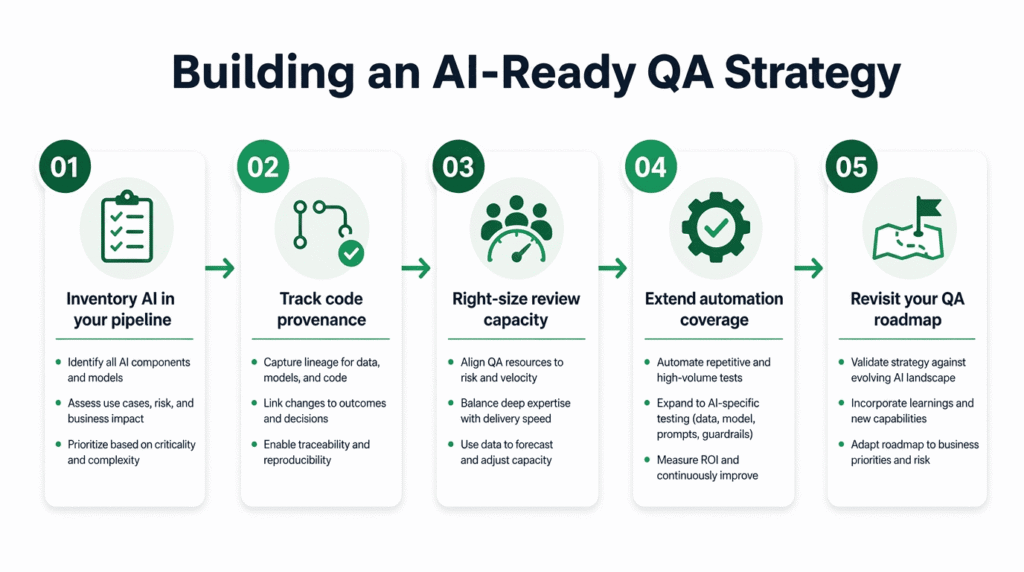
Building an AI-ready QA strategy: five practical steps
- Inventory where AI is already in your pipeline. Most enterprises underestimate this: AI-assisted coding tools spread faster than governance policies do.
- Add provenance tracking to your change history. Know which commits involved AI generation, not just what changed.
- Right-size review capacity to actual output volume, not to headcount from two years ago.
- Extend automation frameworks to cover AI-specific failure modes, such as plausible-but-wrong logic and inconsistent outputs across similar prompts, not just traditional regression paths.
- Revisit your QA Roadmap on a shorter cycle. Annual reassessment is too slow when the underlying delivery model changes fast.
How CelticQA helps enterprise teams stay ahead
This is the work our QA Maturity Assessment & Roadmapping and Test Automation teams are doing with clients right now, not replacing existing QA investment, but recalibrating it for a pipeline that’s moving faster than it was designed for. If your QA strategy hasn’t been reassessed since AI tools entered your delivery process, that’s the gap worth closing first.
FAQ
What is QA in the age of AI? It’s the practice of applying quality assurance discipline, including testing, review, and governance, to software that’s increasingly written or assisted by AI, accounting for failure modes traditional QA frameworks weren’t built to catch.
Does AI reduce the need for QA? No, it shifts where the risk sits. AI increases delivery speed and code volume, which increases the total surface area that needs quality oversight, even as per-line human review time often goes down.
What new risks does AI introduce to software quality? Plausible-but-incorrect logic, inconsistent behavior across similar prompts, unclear code provenance, and compliance gaps when changes can’t be traced back to a clear human decision point.
How does the QA Maturity Model account for AI-generated code? By adding explicit checkpoints for AI-assisted and AI-generated code paths within the existing maturity assessment, not by replacing the framework, but by applying it to a faster-moving target.
What’s the first step to modernizing an enterprise QA strategy for AI? Inventory where AI is already being used in your delivery pipeline. Most enterprises find it’s more widespread than their governance policies currently assume.
Can AI-generated code be tested with the same frameworks as traditionally written code? Largely yes, frameworks need to extend to cover provenance tracking and plausibility testing, checking not just whether it works but whether it actually does what was intended.
The bottom line
AI didn’t lower the bar for software quality. It raised the cost of not having a disciplined QA strategy in place. Enterprise teams that treat this as a governance and maturity question, not just a tooling question, are the ones protecting release confidence as delivery speeds up. If you’re not sure where your QA maturity stands against an AI-accelerated pipeline, that’s exactly what a QA Maturity Assessment is built to answer.
