
A CI/CD pipeline can run every hour and still ship broken software consistently. Speed is not the problem. The missing piece, in most cases, is not more automation — it is the QA strategy layer that tells the pipeline what “done” actually means, and whether the product that just built is safe to release.
The CI/CD maturity trap
Most engineering teams we work with reach a version of the same milestone: they have a working pipeline, meaningful automation coverage, and deployments that run without someone manually pressing buttons. It is a legitimate achievement.
Then they hit the wall. Defects are still escaping. Regression coverage is inconsistent across teams. Nobody can answer “what was tested before this release?” with confidence. The sprint review becomes a negotiation about which failures are blocking and which are not.
The pipeline did not cause these problems. But it did expose them. Before CI/CD, the release cycle was slow enough that QA had time to catch up manually. With CI/CD, any gap in the QA process runs at the speed of the pipeline — which means it compounds.
What teams often discover at this point is that they have automated their execution without building a strategy around what gets executed, when, why, and how the results are used.
What a CI/CD QA strategy actually includes
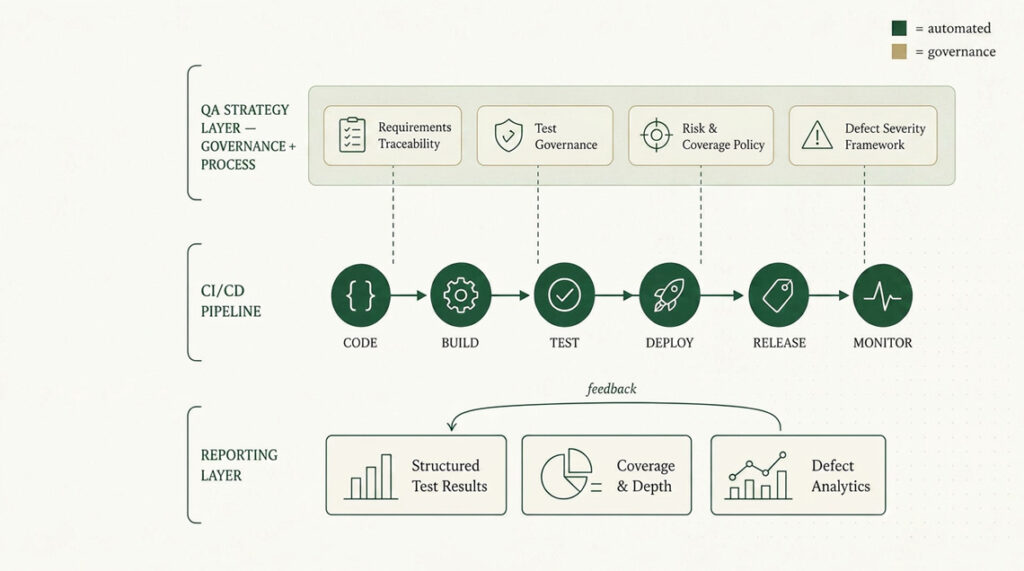
A CI/CD QA strategy is the set of decisions and frameworks that govern how quality is measured, maintained, and reported across a continuous delivery pipeline. It is not a single tool configuration. It includes:
- Test scope governance — which tests run at each pipeline stage (unit, integration, regression, smoke), and who owns each layer.
- Coverage criteria — what “sufficient coverage” means for a given release, by feature type and risk level.
- Feedback routing — where results go after a pipeline run, and who acts on them within what timeframe.
- Defect triage process — how failures are categorized (blocking vs. non-blocking), who makes that call, and how it is documented.
- Reporting standards — what stakeholders see, in what format, and what decisions they are expected to make from that data.
Most CI/CD automation addresses item 1 well. Items 2 through 5 are where QA strategy tends to be thin — and where escaped defects and unreliable reporting originate.
CQA engagement lead or QA practice director on what the most common gap is when teams bring CelticQA in to stabilize a CI/CD QA process
The QA Maturity Model applied to CI/CD
At CelticQA, every engagement starts with a QA Maturity Assessment — a structured review of where a team’s QA practice currently stands across people, process, and tooling. When we apply the QA Maturity Model to teams running CI/CD, a clear pattern emerges.
Teams at lower maturity levels often have strong pipeline infrastructure but weak QA governance: no standardized test planning process, inconsistent coverage documentation, and ad-hoc defect triage. Their pipeline runs fast but their QA records are thin.
Teams at higher maturity levels treat the pipeline as one layer of a broader QA system. They have a QA Roadmap — a forward-looking plan that maps current gaps to targeted improvements — and they know which metrics to track to demonstrate quality outcomes to stakeholders, not just to other QA engineers.
Getting from the first state to the second does not require replacing the pipeline. It requires building the strategy layer around it: governance, documentation standards, and feedback routing that turns pipeline execution into reliable quality evidence.
Curious where your team sits on the QA Maturity Model? Talk to our team — we can walk through a preliminary assessment.
Automation is necessary — but not sufficient
The Accelerate Automation Program at CelticQA exists because automation is genuinely high-value: teams that structure their automation well see up to 80% reduction in manual testing effort, faster regression cycles, and reusable test assets that pay dividends across releases.
But automation in a CI/CD pipeline is a mechanism, not a strategy. A well-configured automation suite running in a poorly governed pipeline still produces unreliable quality signals — because the automation answers “did these tests pass?” but not “are we testing the right things, at the right times, with the right coverage?”
The teams that get the most from CI/CD automation are the ones that have answered those questions first. They know which test layers to automate versus execute manually. They have mapped their automation suite to their risk model. And they have a process for keeping coverage current as the product evolves.
That last point is increasingly addressable with modern tooling. Platforms like QAConnector integrate directly with CI/CD pipelines and surface real-time feedback from every build — which helps teams stay on top of coverage gaps as they appear, rather than discovering them at release time.
What consistent QA feedback looks like in a mature pipeline
When the QA strategy layer is in place, feedback from a CI/CD pipeline looks different. It is not just a pass/fail count from an automation run. It is:
- Structured test results tied to requirements, traceable to the specific build that ran them.
- Coverage data that shows which features were tested, to what depth, and which were not.
- Defect data with severity categorization applied consistently — not informally assigned by whoever is on call.
- Reporting that stakeholders can act on: a QA manager can release with confidence, a product owner can see what shipped and what did not, a CIO can answer an auditor without assembling records manually.
This level of feedback does not emerge from pipeline configuration alone. It comes from the combination of good automation, a connected test management platform, and the QA governance process that gives the data meaning.
Building for the audit, not just the sprint
Engineering leaders in regulated industries — financial services, healthcare, enterprise SaaS — face a version of this challenge that has a compliance dimension. A CI/CD pipeline that produces no structured QA record is not just an internal quality risk: it is an audit exposure.
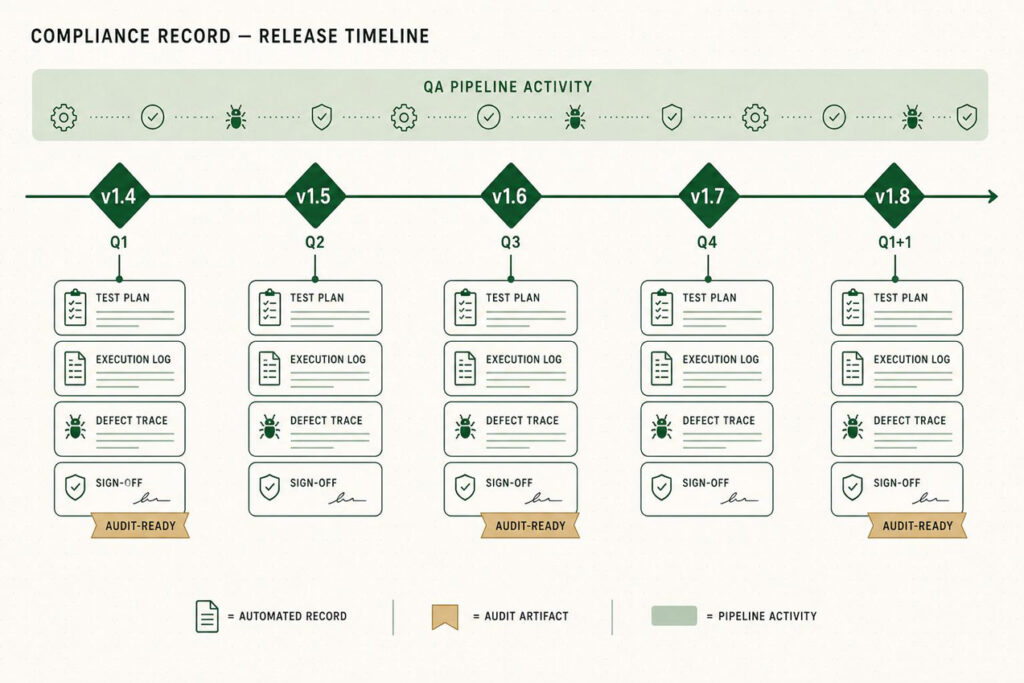
The QA Strategy service at CelticQA includes audit-proof process design — building QA workflows that produce complete, structured, tamper-proof records as a byproduct of normal delivery, not as a fire drill before each review. That means test plans, execution records, defect traceability, and sign-off documentation that exists whether or not an audit is scheduled.
For teams using Independent Verification & Validation (IV&V) as part of their compliance posture, the same principle applies: the evidence has to exist in the delivery record, not be assembled after the fact.
Ready to build a CI/CD QA strategy that survives audits and sprint reviews? Schedule a consultation with our team.
People also ask
Q: What is a CI/CD QA strategy? A: A CI/CD QA strategy is the framework that governs how quality is measured, maintained, and reported across a continuous delivery pipeline. It covers test scope governance (what runs at each stage), coverage criteria, feedback routing, defect triage, and reporting standards. Without it, even a well-instrumented pipeline produces unreliable quality signals.
Q: Why is CI/CD testing not enough on its own? A: CI/CD automation handles test execution. It does not govern what gets tested, at what depth, by what criteria, or how results are used. Teams that automate execution without building QA strategy around it tend to experience inconsistent coverage, unresolved defect categorization, and reporting that doesn’t hold up in reviews or audits.
Q: How does the QA Maturity Model apply to CI/CD pipelines? A: CelticQA’s QA Maturity Model evaluates people, process, and tooling. In CI/CD contexts, higher-maturity teams have strong pipeline infrastructure and strong QA governance: defined coverage criteria, structured test planning, consistent defect triage, and stakeholder-ready reporting. A QA Maturity Assessment identifies which layer needs strengthening first.
Q: What does shift-left testing mean in a QA strategy context? A: Shift-left means moving QA activities earlier in the delivery cycle — writing tests before or alongside features rather than after. In a QA strategy context, it also means governance: who reviews test plans early, what coverage is required before a build enters CI/CD, and how early-stage defects are handled differently from regression failures.
Q: How do you build audit-proof QA documentation in a CI/CD environment? A: By designing QA workflows that generate structured, traceable records as a byproduct of normal delivery. This includes test plans tied to requirements, execution records tied to specific builds, defect traceability from discovery to resolution, and defined sign-off documentation. Tools like QAConnector integrate with CI/CD pipelines to produce this record automatically — the governance process determines that it is complete and meaningful.
Closing
A fast pipeline is a starting point. The engineering teams that get consistent quality outcomes from CI/CD are the ones that have paired that pipeline with a QA strategy: defined coverage criteria, structured feedback routing, and governance that makes quality evidence visible to everyone from the QA engineer to the CIO.
Getting there is not a single sprint. It is a QA maturity journey — one that starts with understanding where the current gaps are and building a roadmap to close them systematically.
That is the work CelticQA does alongside engineering teams. Not arms-length consulting, but embedded partnership — through the first pipeline integrations, the first audit, and the first release where the answer to “what did we test?” takes seconds, not hours.
Ready to build a CI/CD QA strategy your team can rely on? Schedule a consultation.
CelticQA Solutions is a QA services partner with 20+ years of delivery experience across financial services, healthcare, logistics, and more. Learn about our QA services →
