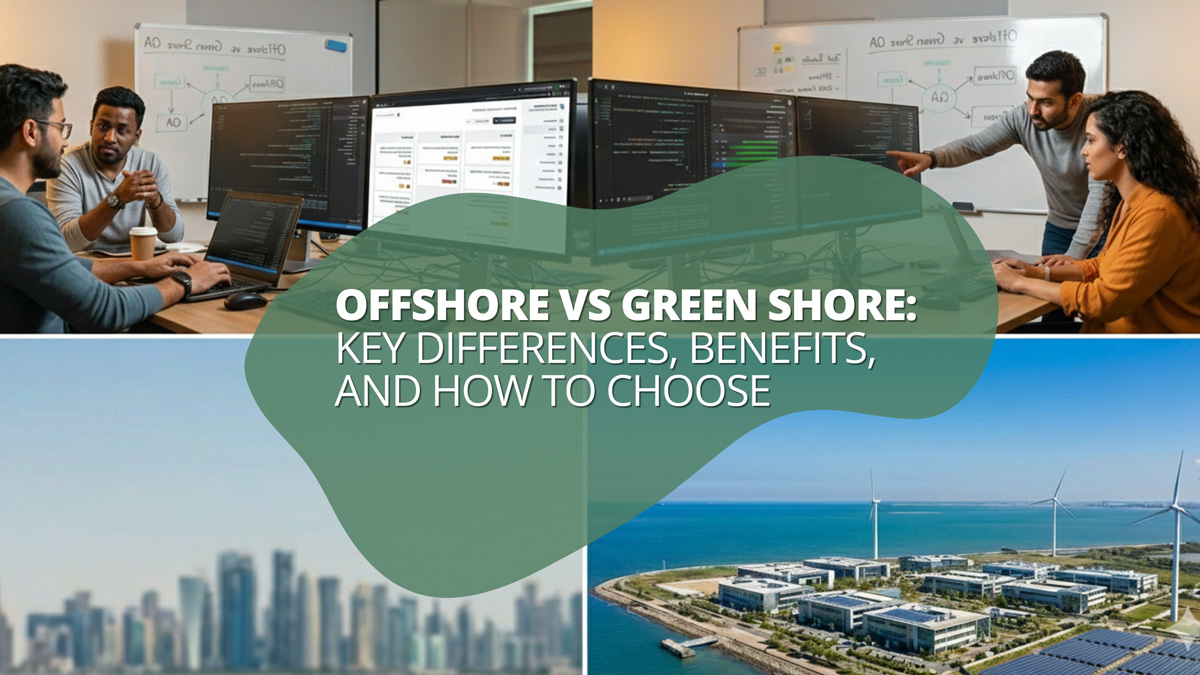
In today’s fast-moving digital landscape, the success of your software initiatives depends on more than just technology—it depends on the team model behind it. For years, organizations relied heavily on offshore outsourcing to reduce costs and scale quickly. But as software becomes more regulated, complex, and integrated into critical business operations, a new model is rising: Green Shore services.
Green Shore teams offer U.S.-aligned collaboration, stronger domain expertise, and higher quality outcomes—making them increasingly attractive to enterprises seeking speed, stability, and compliance.
This guide breaks down the key differences, benefits, and decision criteria to help you choose between Offshore and Green Shore for your QA, development, and IT initiatives.
What Is Offshore Outsourcing?
Offshore outsourcing refers to sourcing software development or QA services from teams located in distant regions—commonly:
- India
- Eastern Europe
- The Philippines
- Vietnam
- Latin America (in some cases)
Historically, organizations adopted offshore models primarily to lower costs while gaining access to large talent pools. Offshore teams often support:
- Software development
- Manual and automated testing
- Regression cycles
- Maintenance tasks
- Support activities
Why companies choose offshore:
- Lower hourly rates
- Ability to scale large teams
- Access to diverse technical skills
But offshore outsourcing’s effectiveness varies significantly depending on project type, communication needs, regulatory environment, and quality requirements.
What Is Green Shore Outsourcing?
Green Shore is an emerging services model where companies partner with U.S.-aligned teams that operate in overlapping time zones, follow stronger quality frameworks, and maintain closer cultural and regulatory alignment. It delivers many advantages of onshore services—without the high cost structure or resource constraints.
Green Shore teams are highly effective for:
- Enterprise QA programs
- Test automation development
- CI/CD and DevOps integration
- Healthcare, finance, and government projects
- Agile collaboration requiring daily communication
What makes Green Shore different:
- Real-time collaboration with U.S. teams
- High compliance fit (HIPAA, SOX, FDA, PCI, CMS, etc.)
- Culturally aligned communication and work practices
- Lower attrition, more stable teams
- Consistent quality and faster delivery cycles
Green Shore bridges the gap between cost efficiency and quality—something offshore models struggle with in regulated industries.
Offshore vs Green Shore: Key Differences
Below is a breakdown of the most critical differences that impact productivity, cost, quality, and long-term ROI.
Cost and Total Cost of Ownership
Offshore:
- Lower hourly rates
- Higher hidden costs (rework, delays, missed requirements, communication gaps)
- Quality issues often increase long-term project spend
Green Shore:
- Competitive pricing with fewer hidden costs
- Higher first-time quality
- Faster turnaround reduces overall project timelines
Bottom line: Offshore’s low hourly rates no longer guarantee total savings—especially in QA-heavy or compliance-driven work.
Quality and Skill Alignment
Offshore:
- Skill levels vary widely between vendors
- Limited experience in U.S. healthcare, finance, gov requirements
- Gaps in understanding domain-specific processes
Green Shore:
- Strong domain expertise
- Familiarity with U.S. regulatory frameworks
- Higher accountability and consistent quality standards
This is especially important for:
- EPIC/EHR testing
- Financial risk systems
- Government platforms
- Pharma/FDA software
- High-volume automation frameworks
Communication and Time Zones
Offshore:
- 8–12 hour time difference
- Delayed issue resolution
- Limited overlap slows Agile rituals (standups, grooming, planning)
Green Shore:
- Same-day collaboration
- Faster decision-making and defect resolution
- Continuous alignment in Agile sprints
In QA environments, where blockers can halt entire teams, these differences are significant.
Collaboration and Culture Fit
Offshore:
- Cultural and communication gaps affect clarity
- Project managers often act as translators
- Collaboration slows under high complexity
Green Shore:
- Teams work similarly to U.S. onshore staff
- Fewer misunderstandings
- Better adoption of Agile, DevOps, and rapid iteration models
Security, Compliance, and Risk
For regulated industries, this may be the largest differentiator.
Offshore:
- Complex compliance requirements
- Data residency restrictions
- Increased oversight needed
- Regulatory misalignment leads to higher project risk
Green Shore:
- Easier to align with HIPAA, PCI, SOX, CMS, and other frameworks
- Stronger data governance
- Lower compliance risk
- Transparent oversight and reporting
Scalability and Flexibility
Offshore:
- Easy to scale large teams
- But high turnover and retraining costs can disrupt momentum
Green Shore:
- Moderate scaling capabilities
- Higher stability and lower attrition
- More predictable productivity
Benefits of Offshore Outsourcing
Despite challenges, offshore may still make sense for:
- Non-regulated industries
- Low-risk, high-volume tasks
- Maintenance or repeatable manual processes
- Budget-limited projects
Key advantages:
- Lower hourly rates
- Large global talent pools
- Easy access to specialty developers (depending on region)
Benefits of Green Shore Outsourcing
Green Shore offers all the advantages enterprises demand in modern software delivery:
Real-time collaboration
Daily alignment accelerates sprints and reduces friction.
Higher quality outcomes
U.S.-aligned standards support process maturity.
Strong domain expertise
Ideal for healthcare, finance, and government.
Faster issue resolution
No overnight delays.
Lower long-term cost
Less rework, fewer blockers, and stronger QA processes.
Lower compliance risk
Critical for regulated sectors.
Stable team model
Low attrition = preserved tribal knowledge.
Offshore vs Green Shore: Cost Comparison
Many organizations initially select offshore because of the low hourly rate—but discover indirect costs quickly add up.
Hidden offshore costs typically include:
- Increased defect leakage
- QA rework cycles
- Requirements misinterpretation
- Time zone-driven delays
- High turnover
- Oversight and project management overhead
- Compliance risk remediation
Green Shore models reduce these hidden costs by delivering higher quality and real-time communication—leading to faster launches and fewer defects in production.
Which Model Is Best for QA, Testing, and DevOps?
For QA and test automation, Green Shore is often the better choice because:
- Automation requires rapid iteration and daily collaboration
- U.S. regulatory context matters in test case design
- Defect triage is faster with same-timezone teams
- Complex enterprise systems require domain expertise
- Offshore handoffs slow down test cycles and automation maintenance
Offshore can still support regression execution or high-volume manual testing, but critical functions—like automation, strategy, and CI/CD integration—benefit significantly from Green Shore’s alignment and consistency.
How to Choose the Right Outsourcing Model
Use the following criteria when evaluating your outsourcing approach:
1. Budget and TCO
Is the goal lowest hourly rate—or lowest total project cost?
2. Compliance Requirements
Do you operate in healthcare, finance, or government?
3. Speed-to-Market Needs
Is real-time collaboration important for sprint execution?
4. Domain Expertise
Does your project require industry-specific knowledge?
5. Team Maturity
Do you need strategic QA guidance or just task execution?
6. Collaboration Requirements
Can your team manage handoffs, or is daily alignment essential?
7. Risk Tolerance
How critical is quality, stability, and uptime?
Final Recommendations
Choose Offshore if:
- You have large, repetitive tasks
- Your industry is not heavily regulated
- You can tolerate slower communication cycles
- You have strong internal oversight and QA maturity
Choose Green Shore if:
- You operate in healthcare, finance, or public sector
- You need real-time collaboration with U.S. teams
- Quality and compliance are non-negotiable
- You’re building or scaling automation, CI/CD, or strategic QA functions
- You want predictable delivery with lower long-term costs
For most enterprise QA, DevOps, and automation initiatives, Green Shore provides the optimal balance of speed, quality, risk reduction, and cost efficiency—making it the preferred model for organizations scaling critical software systems.
