
QA exists. So why does quality still feel unpredictable?
Your delivery partner says the release is tested. Your project team says it’s tested. So why does every major go-live still feel like a gamble?
It’s the same story whether the work is delivered by a software vendor, a systems integrator (SI), or your own development team.
Most CIOs don’t lack QA. They have testers, test scripts, and a test management tool or two. Yet one project ships cleanly while the next runs into unexpected problems, and when leadership asks how thoroughly a release has been tested, different teams give different answers.
The problem usually isn’t effort or expertise. It’s a lack of consistency, governance, independence, and visibility.
When QA practices vary from project to project, requirements aren’t validated before build, testing gets squeezed as deadlines slip, and the team that built a system is also the one confirming it works, quality becomes impossible to predict.
Adding testers or buying another tool won’t fix that. What’s needed is a structured, independent approach to managing quality: one that improves delivery on today’s project while establishing a consistent framework for the future.
That’s where a Quality Management Office (QMO) makes the difference.
What leadership sees vs. what project teams experience
Low QA maturity looks different depending on where you sit. Leaders see the symptoms; project teams live with the causes.
| What leadership sees | What project teams experience |
| Go-lives that feel unpredictable | Different testing processes across projects |
| No clear answer to “How well tested is this release?” | Inconsistent requirements, coverage, and reporting |
| Limited visibility into quality across projects | Test information scattered across tools and spreadsheets |
| Testing windows that continually shrink | QA involvement beginning too late |
| Defects discovered after production releases | Build teams effectively validating their own work |
| Rising QA costs without measurable improvements | Inefficient resource allocation and duplicated testing effort |
Both perspectives point to the same issue: QA exists, but the organization lacks a consistent, independent, and scalable way to manage it.
Why the common fixes fall short
When quality becomes unpredictable, organizations typically respond by adding resources, increasing testing activity, or investing in new technology. Without a broader strategy, those moves often make an inconsistent process more expensive.
| The common fix | Why it falls short | A better approach |
| Hire more testers | Adds capacity without improving consistency | Establish standards and allocate QA resources based on risk |
| Buy another tool | Creates another silo without addressing process gaps | Connect requirements, testing, defects, and reporting |
| Test harder at the end | Discovers problems when they’re most expensive to resolve | Introduce QA earlier, beginning with requirements |
| Let each project define its own QA process | Makes enterprise-wide quality difficult to measure | Implement a shared QA Playbook |
| Rely on the build team to validate its own work | Puts the builder in the position of grading its own work | Introduce Independent Verification & Validation (IV&V) |
The answer isn’t more testing. It’s better management of quality throughout the delivery lifecycle.
Testing services vs. a Quality Management Office
Most QA providers sell testing capacity. CelticQA delivers quality management, with the independence and authority to tell leadership whether a release is ready. The difference shows up at every stage of delivery:
| Typical QA services | CelticQA’s QMO | |
| Role | Testers supplied to execute scripts someone else defined | Owns quality outcomes: strategy, governance, execution, and the go-live recommendation |
| Where QA starts | When a build is ready to test | At requirements, which are scored for testability before design or build proceeds |
| Independence | Often supplied by, or reporting to, the vendor, SI, or development organization | Independent of the build team and accountable to the client |
| Quality gates | Informal; testing ends when time runs out | Defined entry and exit criteria at every phase, with QA sign-off required for go-live |
| UAT | Business users find defects late | Users validate workflows on a system already stabilized through IV&V |
| Reporting | Test counts and pass rates | Requirements coverage, open risk, and a clear go/no-go readiness view |
| After the project | Ends when the project ends | Playbook, standards, and governance that scale across the portfolio |
| AI | AI used to generate more test scripts | AI-accelerated delivery under human review, plus independent testing of your own AI systems |
Everything in our QMO framework is built to deliver the right-hand column.
CelticQA’s approach: Improve the project while building the framework
At CelticQA, we don’t treat QA transformation as a standalone assessment that ends with a report and a list of recommendations.
We deliver our QMO framework through QMO-led Managed QA: we implement it while actively leading, managing, and executing QA on an initial project. That distinction matters.
Rather than asking an organization to pause delivery while it evaluates its QA maturity, our team works alongside internal stakeholders, development teams, vendors, and SI partners to address immediate project needs. As we become immersed in the project, we assess existing QA practices, identify gaps, establish standards, improve testing processes, learn our clients’ critical systems and applications, and put in place the governance needed to make quality predictable.
The result is twofold: a better outcome on the project underway, and a repeatable framework the organization can extend. From there, the model scales in three stages:
- Pilot. CelticQA leads and executes QA on an initial project, establishing governance and implementing the QMO components that project needs.
- Standardize. As the approach proves its value, the standards, processes, reporting, and governance are extended to additional projects.
- Mature. Automation, metrics, and continuous improvement give the organization a consistent, measurable approach to quality across its technology portfolio.
What does this look like in practice?
At a major healthcare system in Wisconsin, CelticQA established QMO governance, raised the quality of requirements, and provided independent QA leadership on an enterprise application implementation.
During the initial pilot project, the team achieved 100% requirements coverage and identified 72 defects, including issues the vendor’s own testing had not identified.
The same engagement produced an enterprise QA Playbook, a Requirements Quality Scorecard, and testable-requirements training, giving the organization a consistent standard for the projects that follow.
What goes into CelticQA’s QMO framework?
Our QMO framework brings together the people, processes, governance, and technology needed to manage quality consistently. It is organized in three layers: Govern, Verify, and Accelerate.
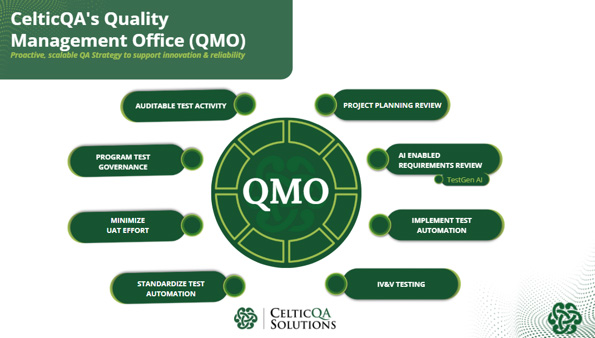
Govern: Set the standard and hold to it
1. QA Playbook: Consistent standards
The QA Playbook defines how quality assurance is performed across the organization: processes, responsibilities, tools, templates, testing standards, and reporting expectations. Rather than each project inventing its own approach, the Playbook establishes a repeatable methodology that adapts to different project types and risk levels.
2. QA Resource Planner: The right level of QA for each project
Not every project needs the same level of testing or oversight. CelticQA’s QA Resource Planner evaluates each project’s business criticality, complexity, and risk to set the appropriate level of QA involvement:
| Risk level | QA approach |
| High | Comprehensive QA leadership, IV&V, and full testing |
| Medium | Targeted QA support and focused testing of the highest-risk areas |
| Low | Minimal formal QA involvement and smoke testing |
This puts QA investment where it delivers the most value, and gives leaders an earlier, more predictable view of QA effort and cost across the portfolio.
3. Governance, Quality Gates, and Release Readiness
Technology leaders need more than test execution statistics. They need clear answers about requirements coverage, outstanding defects, quality trends, and release risk.
Those answers are anchored by defined quality gates. Before design or build begins, requirements are scored against CelticQA’s Requirements Quality Scorecard, and projects that fall below the threshold don’t proceed until the gaps are closed. Design, build, test, and go-live each have their own exit criteria, and go-live requires documented QA sign-off against agreed targets such as pass rate and zero open critical defects.
Verify: Independent confirmation that it’s right
4. Requirements Quality and Traceability
Effective QA begins long before test execution. Our rule is simple: if it can’t be tested, it isn’t ready to be built.
CelticQA evaluates requirements for clarity, completeness, consistency, and testability, using AI-enabled analysis from TestGen AI to accelerate the review. Each project is scored against our Requirements Quality Scorecard (no criterion below 3 and an average of 4 or higher) before design or build proceeds. Requirements are then linked to test cases and results, so teams can see exactly what has and hasn’t been validated.
5. Independent Verification & Validation
When the same organization builds and validates a solution, important risks go unrecognized. Independence only matters if it has teeth. In a CelticQA engagement, IV&V is not a second pass of the build team’s test scripts; it is an independent line of accountability to the client’s business and IT leadership. In practice, that means:
- Verification before build. We confirm that requirements are complete and testable and that the design actually matches them before build begins.
- Validation against your business, not the build team’s script. We test real end-to-end workflows, integrations, and negative and edge-case scenarios rather than re-running the build team’s happy-path tests.
- Oversight of vendor, SI, and internal team testing. We review build-team test plans and evidence, track every defect centrally regardless of who found it, and only QA can close a defect.
- Quality gates that are enforced. UAT doesn’t start until the system has passed IV&V, so business users validate workflows instead of discovering defects, and UAT effort stays focused and short.
- An independent go-live recommendation. Leadership gets an objective view of coverage, open risk, and readiness from a party with no stake in hitting the delivery date.
That is the difference between having testers on a project and having an independent quality authority. It is especially valuable during major technology transformations and business-critical implementations.
IV&V isn’t about policing the build team. Clear acceptance criteria, early requirements validation, and a stable path into UAT make delivery smoother for vendors, SIs, and internal developers alike.
6. Test Strategy, Design, and Execution
Knowing how to execute a test is only part of effective QA. Experienced QA professionals understand what needs to be tested, which scenarios carry the greatest risk, and where defects are most likely to occur.
CelticQA develops risk-based test strategies, designs meaningful test cases, manages execution, and validates both technical functionality and business outcomes.
Accelerate: Do more, faster, without lowering the bar
7. Test Automation Strategy
Automation should be driven by value, not by the number of scripts created. CelticQA evaluates which testing activities to automate based on risk, repeatability, execution frequency, and maintenance cost. The objective is sustainable automation that reduces repetitive effort, speeds regression testing, increases build confidence, and improves release efficiency.
The results are measurable. At Shaw Industries, CelticQA’s regression automation generated $1.46 million in annual execution savings and saved more than 35,000 hours. At Boston Children’s Hospital, regression cycle times fell by 90%.
8. Human-Led, AI-Enabled Quality Assurance
AI makes QA faster, but it can’t replace experienced judgment. CelticQA combines human expertise with AI-enabled capabilities to accelerate requirements validation, test case generation, legacy test case analysis, and automation development. Our QA professionals provide the business context, critical thinking, and independent judgment to decide what matters most and to validate the results.
AI also changes what needs to be tested. As organizations deploy chatbots, copilots, RAG-based knowledge assistants, and AI agents, the same independent discipline has to extend to systems that don’t behave the same way twice. CelticQA is extending its IV&V methodology to AI systems, evaluating functional accuracy and hallucination rates, safety under adversarial prompting, bias and fairness, security risks such as prompt injection and data leakage, and performance and cost, aligned with frameworks such as the NIST AI Risk Management Framework and ISO/IEC 42001.
Our own use of AI follows the same standards we hold clients to: every AI-generated artifact is reviewed by a qualified consultant before delivery, and client-confidential or regulated data is never used in AI tools that haven’t been vetted and approved.
AI increases our capacity. Human expertise ensures quality.
9. QAConnector: One auditable source of truth
CelticQA’s QA management platform, QAConnector, is the single source of truth for quality across the client, its vendors and SI partners, internal development teams, and CelticQA. It supports requirements traceability, test and defect management, UAT coordination, and real-time reporting, and its TestGen AI module accelerates test case generation under human review.
Every defect is tracked centrally regardless of who found it, and every test activity is recorded and auditable, which matters in regulated industries such as healthcare. The technology supports the framework; the real value comes from the people and processes that make it effective.
Frequently asked questions
What is a Quality Management Office (QMO)?
A QMO establishes a consistent framework for how quality assurance is planned, governed, executed, measured, and improved across an organization.
How is a QMO different from a traditional QA team?
A QA team tests. A QMO governs, verifies, and is accountable for quality outcomes. CelticQA provides both: hands-on QA execution and the independent management framework behind it.
How is IV&V different from the testing our vendor, SI, or internal team already does?
Build-team testing confirms that the team built what it intended to build, whether that team is a software vendor, a systems integrator, or your own developers. IV&V independently confirms that what was built meets your requirements, works with your systems and workflows, and is ready for your users, and it reports to you, not to the team that built it. On a recent healthcare implementation, that independent layer surfaced defects the vendor’s own testing had missed.
How does CelticQA implement a QMO?
Through a QMO-led Managed QA engagement. While leading and executing QA on an initial project, our team assesses existing practices, closes gaps, implements improvements, and builds the framework for broader adoption.
Do we need a separate QA maturity assessment before engaging CelticQA?
No. Evaluating existing QA practices is built into the engagement. Our team identifies improvement opportunities while performing the QA work, so you benefit from practical changes right away.
Does every project need the same level of QA?
No. CelticQA’s QA Resource Planner sets the level of QA involvement based on each project’s complexity, criticality, and business impact.
How does AI fit into CelticQA’s QMO framework?
CelticQA uses AI to accelerate selected QA activities, while experienced professionals remain responsible for strategy, judgment, validation, and quality decisions.
Can CelticQA test our AI-enabled applications?
Yes. CelticQA’s IV&V approach extends to LLM chatbots and copilots, RAG applications, AI agents, and machine learning models, covering accuracy, safety, bias and fairness, security, and performance.
How does the framework scale across an organization?
It is established and refined on an initial project. As the processes, governance, and reporting prove their value, the model is extended to additional projects and enterprise-wide initiatives.
Conclusion: Quality should be managed, not left to chance
Most organizations already have people performing testing. What they lack is an independent, consistent way to manage quality across projects.
CelticQA’s QMO framework provides it, combining experienced QA leadership, enforced quality gates, independent verification and validation, risk-based testing, automation, and AI-enabled capabilities. And rather than assessing the problem and handing over recommendations, we put the framework to work while actively delivering QA.
The result: better outcomes on today’s projects and a scalable foundation for tomorrow’s.
CelticQA helps technology leaders go live with confidence.
If you’re preparing for a major technology initiative, experiencing unpredictable releases, or want an objective view of quality, start with an Independent Release Readiness Review. We’ll score the requirements on one in-flight project against our Requirements Quality Scorecard and give you an independent view of go-live risk.
