
QA automation gates are enforced, automated pass/fail checkpoints in your delivery pipeline that stop a build from moving forward until it meets defined quality criteria. Put in[kk1] at build, integration, regression, non-functional, and release stages, they catch defects before customers do, so a release depends on evidence rather than a rushed manual sign-off.

What a CIO should know?
Gates are only worth the investment if you can see the result. Four metrics tell the story:
- Defect escape rate: the share of defects found in production vs. before release. This is the headline number.
- Change failure rate: the percentage of releases that cause an incident or rollback, one of the four key metrics from DORA research.
- Regression cycle time: how long it takes to get a trustworthy answer from your regression gate.
- Critical-path coverage: the share of revenue- and compliance-critical workflows with automated tests behind a gate.
Report these in business terms. “Two fewer customer-facing incidents this quarter” lands better with the board than “test pass rate up 6%.”[kk1]
Production escapes are a leadership problem
A production escape is any defect your customers find before your team does. For a CIO, the defect itself is rarely the hardest part. The aftermath is: an incident bridge, a rollback, a hotfix that pulls engineers off the roadmap, and a conversation with the business about why it happened again.
Most organizations don’t have these escapes because they test too little. They have them because, at the moment of release, testing turns into a judgment call. Deadlines compress, a manual sign-off gets waved through, and a known gap ships “just this once.”
QA automation gates take the judgment call out of the critical path. This post covers what they are, the five gates that matter most, how to roll them out without slowing delivery, and what to measure so you know they’re working. For more practical QA leadership content, explore the CelticQA blog.
What is a QA automation gate?
A QA automation gate is an automated checkpoint in the delivery pipeline that blocks a build from progressing until it passes defined quality criteria, such as test pass rates, coverage of critical paths, or performance thresholds. Unlike a manual review, it’s enforced: it can’t be skipped under deadline pressure.
The word that matters is enforced. Plenty of teams have dashboards that show a red test suite. That’s a warning light. A gate is a locked door. If the criteria aren’t met, the build doesn’t move, and a person has to make a deliberate, visible decision to override it.
Why do defects still escape to production?
In our 20+ years of QA delivery across the US, Ireland, and the UK, the same four patterns show up behind most production escapes:
- Manual sign-off under pressure. When the release date is fixed, the sign-off bends to fit it.
- Coverage gaps on critical paths. The suite is large, but the workflows that carry revenue or regulatory risk aren’t fully covered.
- Flaky tests that get ignored. Once a suite fails intermittently, teams learn to rerun it until it passes, and real failures hide in the noise.
- No traceability at release. Nobody can show, in one place, which requirements were tested and what the results were.
None of these is a tooling problem on its own. Each is a process gap that automation gates are designed to close.
Five QA automation gates that stop production escapes
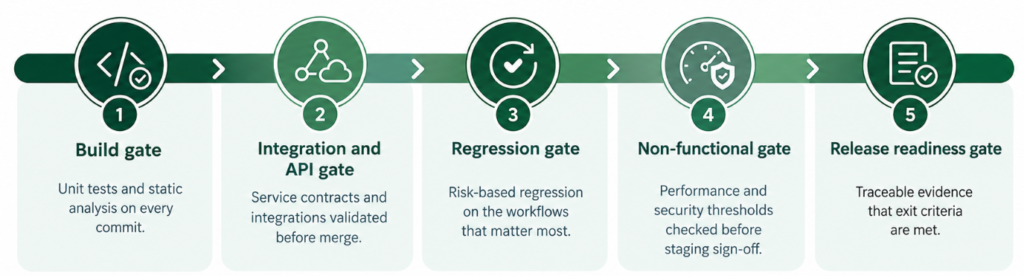
- Build gate: unit tests and static analysis on every commit.
- Integration and API gate: service contracts and integrations validated before merge.
- Regression gate: risk-based regression on the workflows that matter most.
- Non-functional gate: performance and security thresholds checked before staging sign-off.
- Release readiness gate: traceable evidence that exit criteria are met.
1. Build gate. The cheapest defect to fix is the one caught minutes after it’s written. Unit tests and static analysis run on every commit, and a failing build doesn’t merge. This gate lives in your Continuous Integration toolchain, whether that’s Azure DevOps, Jenkins, or Bamboo.
2. Integration and API gate. Many escapes happen at the seams between services, not inside a single component. Automated API testing validates contracts and data flows before code reaches a shared environment.
3. Regression gate. This is where most escapes are stopped, or missed. A regression gate runs the suites tied to your highest-risk workflows and blocks promotion on failure. The goal isn’t to run everything. It’s to run the right things, every time, fast enough that nobody’s tempted to skip them.
4. Non-functional gate. A release can pass every functional test and still fail customers under load. Performance and security thresholds belong in the pipeline, not in a post-release review. The NIST Secure Software Development Framework is a useful reference for which security checks to build in.
5. Release readiness gate. The final gate answers one question with evidence: are we ready to ship? It confirms exit criteria are met and every in-scope requirement has a traceable test result. CelticQA delivers this layer with QAConnector, our QA management platform, so the release decision rests on a record rather than a hallway conversation.
Manual sign-off vs. QA automation gates
| Manual sign-off | QA automation gates | |
| Enforcement | Advisory, can bend under pressure | Enforced, overrides are visible |
| Speed | Waits on people | Runs on every build |
| Consistency | Varies by reviewer | Same criteria, every release |
| Evidence | Email or meeting notes | Traceable test results |
| Where defects surface | Often late, or in production | Early, at the cheapest stage to fix |
Manual testing still matters, especially exploratory testing. What changes is that people stop being the only thing standing between a defect and your customers.
How do you roll out quality gates without slowing delivery?
The biggest objection we hear from engineering leaders is that gates will slow delivery. Rolled out badly, they do. Rolled out in the right order, they speed it up, because teams stop losing days to hotfixes and rework.
Here’s the sequence we use with clients:
- Baseline where you are. Our QA Maturity Model maps your current pipeline, coverage, and risk, and produces a QA Roadmap for where gates go first.
- Start with the three suites that block your release. Stabilize and automate those before adding new gates.
- Fix flakiness before you enforce. A gate built on an unreliable suite gets overridden within a month.
- Automate at scale. Our Accelerate Automation Program delivers up to 80% reduction in manual testing effort, which frees your team to own the gates rather than babysit them.
- Tighten criteria over time. Begin with achievable thresholds and raise them as the suites mature.
We work alongside your QA and engineering leads through this process. The goal is a gate structure your team owns, not one that depends on us. Not sure where to start? Begin with a QA Maturity Assessment & Roadmapping engagement.
FAQ
What is a production escape in software testing? A production escape is a defect that gets past all testing and is found in production, usually by customers or monitoring. Escapes cost more to fix than defects caught earlier, because they bring incident response, rollbacks, and customer impact on top of the fix itself.
What is a good defect escape rate? It depends on your industry, release cadence, and risk profile, so the trend matters more than a single benchmark. Track it release over release. A steady decline after you introduce automation gates is the clearest sign they’re working. [VERIFY: add an industry benchmark only if a credible source is available]
Do quality gates slow down CI/CD? Poorly designed gates can, especially when they run slow or flaky suites. Well-designed gates run fast, targeted checks at each stage and speed delivery up overall, because teams spend less time on hotfixes, rollbacks, and rework after release.
Which tests should block a release? Start with tests that cover your highest-risk workflows: revenue-generating transactions, regulatory or compliance processes, and integrations with critical third parties. Add smoke tests for core functionality and key performance thresholds. Expand the blocking set as suites become stable and reliable.
Can quality gates replace manual QA? No. Gates replace manual sign-off as the only safeguard, not manual testing as a discipline. Exploratory testing, usability review, and edge-case investigation still need skilled testers. Automation handles the repeatable checks, so people can focus on the work that needs judgment.
How long does it take to put automation gates in place? Most teams can enforce a first gate on their most critical suites within one or two release cycles. A full five-gate structure is typically phased in over several quarters, sequenced by risk. A QA Maturity Assessment gives you a realistic timeline for your environment.
Conclusion
Production escapes aren’t a sign that your team isn’t testing. They’re a sign that testing is optional at the moment it matters most. QA automation gates make quality enforceable: every build, every stage, every release, with evidence behind the decision to ship.
Start with the gates that protect your highest-risk workflows, make them reliable, and build from there. If you’d like a partner to design and roll out a gate structure your team can own, schedule a consultation with CelticQA or explore our QA Strategy services.
