
When engineering budgets blow past estimates, QA is rarely the first suspect. It should be. Poor quality assurance — missing test strategies, undertested regression suites, skipped automation — doesn’t show up on the balance sheet until a defect escapes. By then, the cost is three to ten times what early testing would have been.
Why “surprise” budget overruns aren’t actually surprises
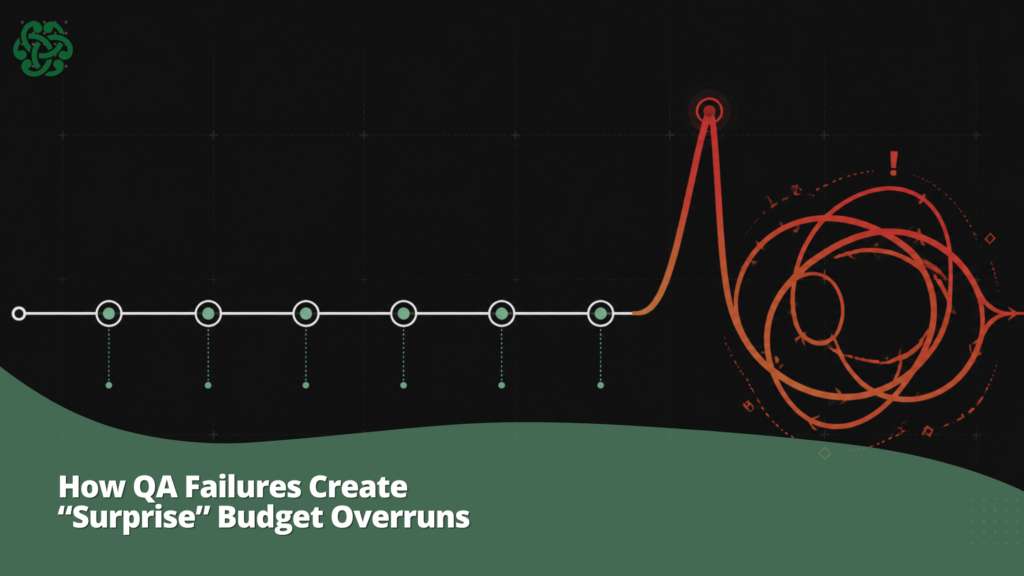
Every unplanned sprint, every emergency hotfix, every delayed release caused by a production defect has a root cause. Most of the time, it isn’t the developer who wrote the code. It’s the absence of QA — the missing test plan, the skipped regression run, the automation coverage that never got built.
Engineering leaders are often surprised by these costs because QA investment is easy to defer. It doesn’t fail visibly in the moment. Cutting a QA sprint doesn’t crash the app today. It crashes the budget three months later, in a way that gets attributed to “complexity” or “scope creep” rather than the QA gap that set it up.
The Consortium for Information & Software Quality (CISQ) estimates that poor software quality costs the U.S. economy at least $2.41 trillion annually. That figure encompasses operational software failures, unsuccessful development projects, and the ongoing burden of maintaining legacy systems. CISQ also estimates that accumulated software technical debt has reached approximately $1.52 trillion. While the exact impact varies by organization, the pattern is consistent: QA debt compounds quietly until it surfaces as costly production failures, delayed releases, or modernization efforts that become increasingly difficult to execute.
Where QA costs hide on the balance sheet
When QA is inadequate, costs don’t appear as a “QA” line item. They show up as:
Emergency hotfixes. A post-release defect requires dedicated developer and QA time outside normal sprint cycles. At typical hourly rates, a four-day emergency fix cycle can cost as much as two full regression testing cycles would have.
Delayed releases. A failed release gate stops delivery momentum. In regulated industries, a delayed release can also trigger contract penalties or compliance review cycles.
Customer-facing incidents. A defect that reaches a customer creates support load, potential churn, and reputational cost. For SaaS businesses, a single major incident can affect renewal rates across a customer segment.
Rework cycles. Defects found late in the SDLC are expensive to trace, isolate, and fix. A defect caught in unit testing costs a fraction of what the same defect costs when found in UAT — or by a customer.
Compliance exposure. In healthcare, financial services, and logistics, a defect touching a regulated workflow can require audit-level investigation and remediation, adding cost and time that was never budgeted.
None of these costs disappear when QA is present — but a mature QA strategy identifies and contains them before they become budget events. That’s what a documented QA strategy is for: making risk visible before it becomes expense.
Five QA gaps that reliably turn into budget overruns
Most budget surprises trace back to one of these five patterns. If your organization recognizes more than two, a QA Maturity Assessment is likely overdue.
1. No formal test strategy
Without a documented test strategy, QA coverage is informal and inconsistent. Different team members test different things at different depths. Regression testing happens when someone remembers. High-risk features get the same attention as low-risk ones — or less. The result: defects escape. Not because the team is unskilled, but because there’s no system ensuring the right things are tested at the right time.
2. Manual-only testing with no automation coverage
Manual testing scales with headcount, not with codebase growth. As a product grows, manual-only testing falls further behind coverage needs. Teams make up the difference by reducing regression depth — which is exactly the wrong trade. Test automation, particularly the regression automation delivered through CelticQA’s Accelerate Automation Program, can reduce manual testing effort by up to 80% while improving regression coverage and cycle time simultaneously.
3. No QA maturity baseline
Without knowing where QA currently stands, teams can’t improve it deliberately. The QA Maturity Model provides the framework that maps current state, identifies gaps, and produces a QA Roadmap the team can actually execute. Many organizations discover through a maturity assessment that their biggest cost driver isn’t the defects they’re catching — it’s the defects they’re not.
4. Skipped regression testing before major releases
Release pressure is the most common reason regression gets cut. “We’ll do a quick smoke test and ship it.” When this happens, the implicit bet is that nothing the new code touched will break existing functionality. That bet loses more often than teams expect. A well-structured regression suite, run as part of a Continuous Integration pipeline (celticqa.com/services/continuous-integration/), removes regression from the release-day pressure equation. It either passes or it doesn’t — and if it doesn’t, the team finds out before the customer does.
5. No defect governance or trend reporting
QA generates data. Without governance, that data doesn’t go anywhere useful. Defect escape rate, regression failure trends, time-in-test, and coverage metrics should all be visible to engineering leadership — not just the QA team. When these metrics aren’t tracked, budget overruns feel like surprises. When they are tracked, the warning signs are visible weeks before a release failure. QAConnector, CelticQA’s test management platform, is built specifically to surface this kind of real-time visibility.
What does a post-release defect actually cost?
Research consistently supports the same rule of thumb: the later in the SDLC a defect is found, the more it costs to fix.
| Where the defect is detected | Relative cost impact |
| Requirements / Design | Lowest |
| Development | Higher |
| Integration / System Testing | Significantly higher |
| User Acceptance Testing | High |
| Production | Highest |
While the exact financial impact differs by organization, the trend is universal: the longer a defect remains undetected, the more expensive it is to fix and the greater its business impact.
These aren’t academic numbers. They reflect the compounding cost of additional developer context-switching, QA retest cycles, release re-staging, customer communication, and in some cases regulatory reporting. The implication is direct: the earlier QA is embedded, the cheaper quality becomes. QA is not a cost of building software. It’s the mechanism by which the much larger cost of building it wrong gets avoided.
Building QA that prevents — rather than reacts
Reactive QA, testing at the end of a cycle, patching after release, adding testers when defect rates spike is expensive QA. It applies the highest-cost fix to problems that earlier detection would have caught for a fraction of the price.
Preventive QA means:
- A documented QA strategy that defines test scope, risk-based prioritization, and coverage expectations for each release type.
- A QA Maturity Assessment that gives engineering leadership an honest current-state view and a roadmap for targeted improvement.
- An automation program that removes manual bottlenecks from regression and scales with the codebase — not with headcount.
- Governance and reporting that puts defect trends and coverage data in front of the people who make release and investment decisions.
Ready to find out where your QA gaps are? Start with a QA Maturity Assessment & Roadmapping engagement — map your current state and show you exactly where the risk lives.
FAQs: People also ask
What is the cost of poor software quality?
The cost of poor software quality (COPQ) is the total cost an organization incurs when software fails to meet quality expectations. It includes the costs of defect remediation, emergency hotfixes, rework, delayed releases, production incidents, customer dissatisfaction, compliance efforts in regulated industries, and the ongoing burden of technical debt. According to the Consortium for Information & Software Quality (CISQ), poor software quality costs the U.S. economy at least $2.41 trillion annually, highlighting the significant financial impact of software failures across industries.
How much does it cost to fix a bug found after release?
Defects found in production are significantly more expensive to fix than those identified during requirements, design, or development. By the time a defect reaches production, organizations may incur costs related to incident response, root cause analysis, emergency fixes, regression testing, redeployment, customer support, business disruption, and—in regulated industries—compliance or reporting activities. While the exact cost multiplier varies by organization, industry research consistently shows that the cost of fixing defects increases substantially the later they are discovered in the software development lifecycle.
What are the most common QA process failures?
The most common QA failures are: no formal test strategy (coverage is informal and inconsistent), manual-only testing that can’t scale with codebase growth, skipped regression before releases, no defect governance or trend reporting, and no QA maturity baseline to measure improvement against.
How can engineering teams reduce unexpected software costs?
The most effective approach is investing in preventive QA: a formal test strategy, regression automation, a QA Maturity Assessment to identify gaps, and governance that surfaces defect trends before they become release failures. Embedding QA earlier in the SDLC has the highest return rate. The earlier defects are caught, the cheaper they are to fix.
What is QA ROI and how is it measured?
QA ROI measures the cost of quality assurance investment against the cost it avoids. Common metrics include reduction in post-release defect rate, reduction in regression testing cycle time, reduction in emergency hotfix spend, and reduction in rework hours. A mature QA program typically returns multiple dollars in avoided costs for every dollar invested in testing.
When QA is absent or inadequate, budget overruns aren’t bad luck — they’re a predictable outcome. The good news is that QA gaps are identifiable, and closing them is an investment that pays back in avoided emergency spend, shorter regression cycles, and release confidence engineering leadership can stand behind.
If your team is recognizing patterns from this post, the next step is a conversation. Schedule a consultation with CelticQA and we’ll show you where the gaps are and what closing them looks like in practice.
