When organizations partner with a System Integrator (SI), the goal is clear: implement new technology smoothly, efficiently, and with minimal disruption. SIs are essential partners in making that happen.
But problems begin when the SI moves from being a key contributor to being the one in the driver’s seat—controlling requirements, testing, timelines, readiness decisions, and even the narrative surrounding project “health.”
This dynamic puts companies at risk, often without realizing it until it’s too late.
In this article, we break down the truth about SIs driving your implementation and how independent QA oversight protects your timelines, quality, stakeholders, and ultimately, your business.
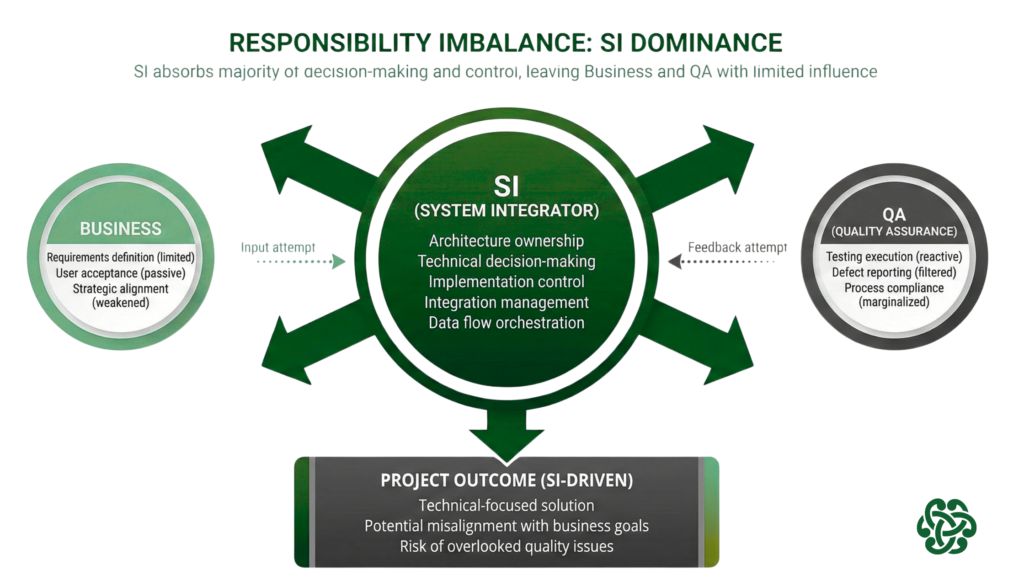
What It Really Means When Your SI Is “In the Driver’s Seat”
At face value, letting an experienced SI guide your implementation sounds reasonable—they’ve done it many times, they know the system, and they bring best practices.
But in many implementations, “driving” means much more than that.
It often means the SI is:
- Running the PMO
- Defining requirements
- Developing and testing features
- Reporting their own progress
- Making readiness recommendations
- Controlling communication flows
- Influencing go/no-go decisions
That level of control creates a single point of dependency, which can leave your organization blind to what’s actually happening inside the project.
Instead of transparency, you get dashboards.
Instead of real quality metrics, you get summaries.
Instead of independent validation, you get assurances.
And assurances are not a substitute for accountability.
The Risks That Come With SI-Controlled Implementations
When your SI is driving everything, the risks aren’t always obvious on day one—but they become painfully clear by the time timelines slip, defects stack up, or go-live becomes chaotic.
Here are the biggest pitfalls.
1. Misaligned Incentives
SIs do outstanding work—but they are still vendors with business models.
Their incentives are often tied to:
- Billable hours
- Delivering scope as quickly as possible
- Keeping teams fully utilized
- Protecting the narrative of successful delivery
This means that velocity often gets prioritized over quality, and bad news sometimes gets delayed or diluted.
Your organization ends up managing risk reactively instead of proactively.
2. No Independent Validation of Quality
If the same party building the system is also testing it and reporting the results, you don’t have visibility—you have a conflict of interest.
Common issues include:
- Defects being re-categorized to avoid reporting
- Reduced test coverage
- Critical defects discovered too late
- “Green” project statuses that hide quality gaps
Organizations often believe everything is on track until independent QA enters the picture—and uncovers serious readiness risks.
3. Budget Overruns & Timeline Slippage
When the SI controls the plan and the narrative, it becomes easy to:
- Push issues to future sprints
- Underestimate work
- Delay risk disclosures
- Mask root causes of timeline slips
By the time the business sees the truth, the project is already overspent or slipping—sometimes by months.
Independent QA provides early visibility, giving leaders the insight they need to intervene before costs escalate.
4. Business Misalignment
When SIs drive the project, business stakeholders often get looped in far too late.
That leads to:
- Misinterpreted requirements
- Missed edge cases
- Low adoption at go-live
- Solutions that technically work but don’t fit real workflows
When these gaps surface late, they become expensive rework.
5. Vendor-Led QA Is Not Real QA
An SI testing their own work is not quality assurance—it’s quality confirmation.
Without a neutral party:
- Assumptions go unchallenged
- Gaps go unnoticed
- Quality gates lose meaning
- Go-live decisions are influenced by delivery pressure
Simply put:
Your SI cannot be the sole guardrail protecting your organization.
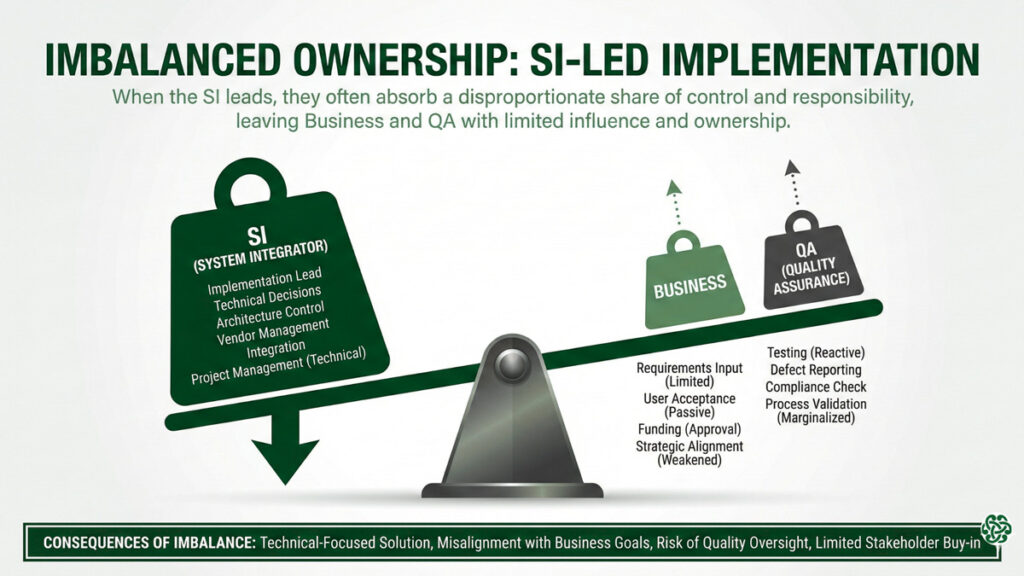
Warning Signs Your SI Is Driving Too Much
If any of these feel familiar, your SI has too much control:
- You rely on SI dashboards without seeing raw test evidence
- Critical issues are deprioritized or labeled as “known defects”
- You hear “that’s out of scope” too frequently
- Go-live dates stay fixed even when deliverables slip
- Leadership only gets high-level status summaries
- The business feels disconnected from decision-making
If one or more apply, your team isn’t behind the wheel—you’re in the passenger seat.
Why Your Organization Must Take Back the Steering Wheel
To protect your investment, your organization—not your SI—must own:
- Vision
- Requirements
- Quality gates
- Acceptance criteria
- Readiness decisions
Ownership doesn’t mean doing all the work.
It means controlling how it gets done and ensuring all decisions align with your business—not the SI’s comfort zone.
When you regain control, you get:
- Truthful visibility
- More predictable delivery
- Fewer surprises
- A system aligned with real business needs
- Reduced rework and risk
This shift is essential for long-term success.
How Independent QA Protects Your Organization
Independent QA oversight is the safeguard that keeps your SI accountable while empowering your internal teams.
Here’s how it protects you:
1. Objective Validation
An unbiased view of quality, coverage, and risk gives leaders the truth—not filtered reporting.
2. Transparent Evidence
Independent QA verifies actual results, not interpretations of results.
3. Early Risk Identification
You learn about issues early enough to act on them—before they snowball.
4. Clear Go/No-Go Insight
Independent QA ensures go-live decisions reflect reality, not pressure.
5. Alignment With Business Outcomes
QA keeps the solution grounded in what your teams actually need—not just what can be delivered quickly.
Independent QA transforms chaotic implementations into predictable ones.
A Better Model: Balanced Leadership With Independent QA
A modern implementation model distributes responsibility where it belongs:
The SI
Builds, configures, and provides system expertise.
The Business
Owns decisions, requirements, and success criteria.
Independent QA (CelticQA)
Provides validation, visibility, and protection through:
- QA oversight
- QMO structure
- Test automation
- Readiness assessments
- Hypercare QA support
- Continuous risk analysis
This model gives you the benefits of your SI—without the blind spots that come from vendor-controlled delivery.
Your SI Should Be a Partner—Not the Driver
Your SI plays a vital role in delivering new technology, but when they’re in the driver’s seat, your organization loses the visibility and control needed to ensure a successful outcome.
By adding independent QA oversight, you gain:
- Protection
- Predictability
- True visibility
- Confidence in every decision
- A system that meets your business needs—not just technical requirements
If you want a partner that strengthens your SI relationship while protecting your organization, CelticQA is here to help.
Ready to regain control of your implementation?
Let’s talk about building true visibility into your project.
